
How VFD-Driven Centrifugal Pumps Reduce Energy Consumption in Dairy Processing
April 4, 2026
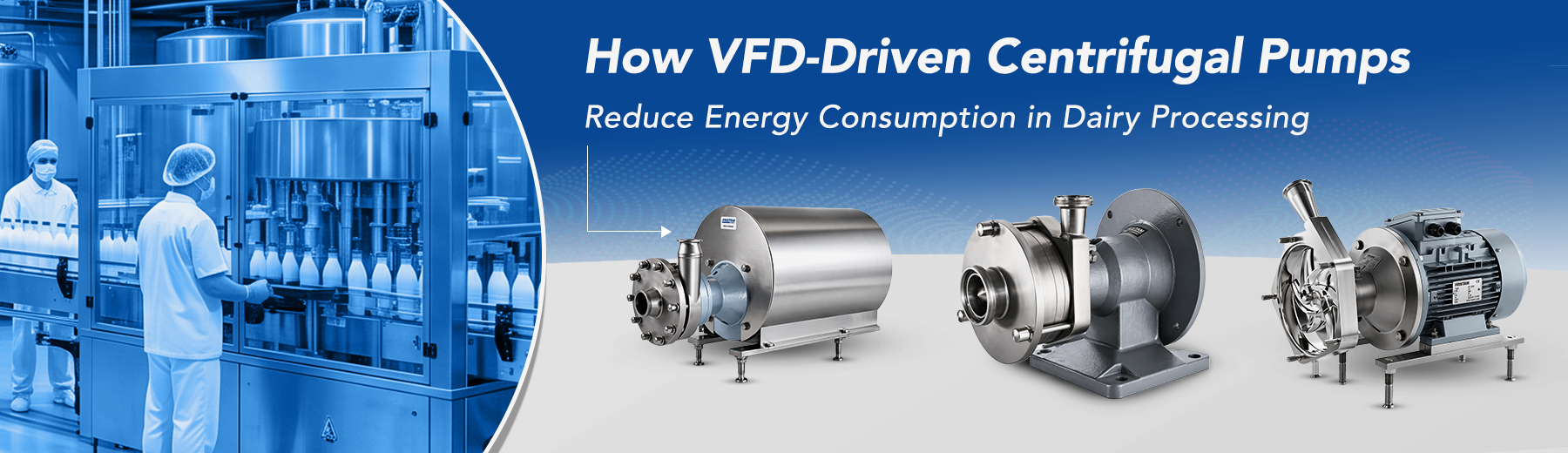
Walk into any large-scale dairy facility, and you'll find one piece of equipment that never really stops. The centrifugal pump . It pulls raw milk from tankers, pushes product through pasteurisers, keeps refrigeration loops circulating, and drives cleaning systems between every production run. It's everywhere. And most plants are running it wrong.
Here's what's actually happening in a majority of facilities right now. Their dairy processing pumps run at full motor speed around the clock. Mechanical valves then throttle the flow down to whatever the process needs at that moment. You're burning 100% power to deliver 60% output. The rest converts to heat, noise, and wear. That's not a minor inefficiency. That's a structural problem with how the system was designed.
According to the Hydraulic Institute, energy costs account for nearly 85% of a pump's total lifetime cost over its operational life. Not the capital purchase. Not spare parts or servicing. Energy. That single statistic reframes the entire conversation about pump investment.According to the Hydraulic Institute, energy costs account for nearly 85% of a pump's total lifetime cost over its operational life. Not the capital purchase. Not spare parts or servicing. Energy. That single statistic reframes the entire conversation about pump investment.
According to the Hydraulic Institute, energy costs account for nearly 85% of a pump's total lifetime cost over its operational life. Not the capital purchase. Not spare parts or servicing. Energy. That single statistic reframes the entire conversation about pump investment.
Understanding Centrifugal Pump Energy Efficiency via the Cube Law
The Affinity Laws are a set of fluid dynamics principles that describe how centrifugal pump efficiency responds to changes in rotational speed. Three relationships define everything:
- Flow rate varies in direct proportion to pump speed
- Pressure head varies with the square of pump speed
- Power consumption varies with the cube of pump speed
Benefits of VFD Pumps in Dairy Processing Plants
The electricity savings are the headline number. Fine. But the full picture of the benefits of VFD pumps in dairy processing plants is broader, and in some ways more operationally significant than the energy figures alone. Dairy is not a forgiving environment. Products are biologically sensitive. Cleaning protocols are legally mandated. Equipment downtime directly impacts production volume and food safety compliance. Speed control touches all of it.
1. Improving Product Integrity Through Speed Control
Speed damages the product. That's not an overstatement. At high rotational speeds, a centrifugal pump generates shear forces sufficient to rupture fat globules in whole milk, which disrupts natural fat distribution and affects texture in the final product. In fermented dairy lines, yogurt cultures that took hours to develop can be physically torn apart by an over-speed pump transfer.
Pump speed control using VFD gives operators precise authority over flow at every stage. Slow, gentle movement through fermentation transfers. Higher throughput during tanker intake, where shear risk is lower. The control is continuous and responsive, not a binary on-off decision made by valve position.
2. Enhancing CIP (Clean-in-Place) Operations
Pumps used in dairy industry facilities have a dual role that's often underappreciated. They handle the product during production and then immediately switch to driving CIP circuits once a run ends. These are very different hydraulic requirements.
Effective CIP needs turbulent, high-velocity flow to mechanically scour deposits from pipe walls, heat exchanger plates, and vessel surfaces. Rinsing needs a lower velocity laminar flow. A fixed-speed pump satisfies neither condition well. A VFD-controlled dairy processing pump can shift between these flow regimes precisely, cutting water usage per CIP cycle and reducing chemical concentration requirements. Both are real cost savings.
3. Reducing Mechanical Stress and Maintenance
Every direct online motor start creates a small mechanical shock. The shaft jumps to full speed quickly. Bearings and seals absorb the stress. Repeated cycles increase wear and maintenance costs.
VFDs ramp speed gradually on start and decelerate smoothly on stop. Water hammer disappears. Seal face stress reduces significantly. Bearing temperatures stabilise at lower operating levels. Your dairy industry pumps simply last longer between interventions. Fristam's FP series is already built with a self-aligning shaft that minimises seal face stress, and the combination with VFD soft start makes it an extremely low-maintenance platform.
Sustainability and the Bottom Line: Calculating ROI
The business case for energy-efficient dairy processing pumps has become more straightforward over the past few years. Energy costs have risen. Sustainability disclosures are increasingly expected by institutional buyers, export customers, and regulatory bodies in several key markets.
VFD-equipped pumping systems in dairy plants usually recover costs within six to eighteen months. Actual timelines vary with operating hours, electricity tariffs, and load conditions. High-volume plants at partial loads see faster payback. Indirect savings also add up. Fewer failures reduce maintenance costs. Lower CIP usage cuts utilities. Reduced shear damage improves product quality consistency.
A practical example: Consider a 15 kW centrifugal pump running 16 hours daily across 300 production days. At 80% average flow demand under VFD control, annual power consumption drops from roughly 72,000 kWh to around 37,000 kWh. At Rs 8 per unit, that single pump saves approximately Rs 2.8 lakh a year. A facility running eight to ten comparable pumps sees returns that fully justify the capital outlay within the first year of operation.
Why Fristam Is the Leader in Dairy Industry Pumps?
Fristam designed the fp centrifugal pump range for sanitary processing environments. It uses open impellers with tightly controlled gaps between the impeller face and casing cover. This setup supports gentle flow and reduces shear during transfer. At the same time, volumetric efficiency stays strong.
The specifications show serious engineering intent. Fourteen sizes are available. System pressure reaches 25 bar. Flow rates go up to 550 m3 per hour. Viscosity handling extends to 800 mPa.s. The self-aligning shaft helps prevent seal damage during installation. It reduces early failures in actual plant use.
Pair Fristam's hydraulic efficiency with a correctly specified VFD, and you build a pumping system that actively reduces energy consumption, handles product gently, and stays in service longer. The tight tolerances and premium-grade stainless steel castings that define Fristam's manufacturing standard make these pumps a robust platform for pump speed control using VFD in demanding applications.
The FP series serves dairy processing operations, chemical industries, and beverage and brewing facilities. All are sectors where centrifugal pump energy efficiency, hygiene compliance, and operational reliability are baseline requirements, not optional considerations.
Conclusion
The direction is clear. Energy-efficient dairy processing pumps are becoming the standard, not the exception. Rising energy tariffs, sustainability commitments, and buyer expectations from domestic and export markets are collectively making fixed-speed throttled operation harder to justify economically.
VFDs ramp speed gradually on start and decelerate smoothly on stop. Water hammer disappears. Seal face stress reduces significantly. Bearing temperatures stabilise at lower operating levels. Your dairy industry pumps simply last longer between interventions. Fristam's FP series is already built with a self-aligning shaft that minimises seal face stress, and the combination with VFD soft start makes it an extremely low-maintenance platform.
If your plant is still running dairy industry pumps against a mechanical valve with no speed control, that's the conversation to have with your engineering team this quarter. Contact Fristam for an energy audit of your pumping system and find out exactly where your facility stands.
FAQ's
1. How much energy can a VFD actually save on a centrifugal pump in a dairy plant?
Most real-world installations report reductions between 20% and 60%, depending on how far average operating demand sits below full pump speed. Facilities with highly variable flow requirements, like those running both product and CIP on the same circuits, tend to see savings toward the higher end of that range.
2. Can we retrofit a VFD to centrifugal pumps that are already installed in our plant?
In most cases, you can, without replacing the pump body or impeller. The VFD connects to the existing motor. Before proceeding, it's worth having a qualified engineer check the motor's insulation class and bearing specification, since some older motors need minor upgrades to handle VFD-generated waveforms without accelerated wear.
3. Does running a centrifugal pump at lower speeds affect its ability to maintain hygienic flow conditions?
It's a valid concern, and one that needs proper system design to address. VFDs are programmed with minimum speed thresholds that maintain required flow velocities for hygienic transport and CIP turbulence. The key is commissioning the VFD with process-specific parameters, not just installing it and leaving defaults in place.
4. How does VFD speed control actually protect product quality during dairy transfers?
Shear force on the product scales with impeller tip speed. By reducing rotational speed during sensitive transfers, like moving fermented cultures or cream fractions, the centrifugal pump generates significantly lower shear. Fat globule integrity is maintained, gel structures in fermented products stay intact, and final product texture and stability improve as a result.
5. What's the realistic maintenance difference between VFD-driven and fixed-speed dairy processing pumps?
The most visible difference shows up in mechanical seal and bearing replacement frequency. Soft start eliminates the radial shock load that accelerates seal face wear on direct-on-line starts. In typical dairy operations, facilities report meaningful reductions in seal replacement frequency after VFD installation, and a lower incidence of bearing failures tied to vibration and thermal cycling.