
The Rise of Plant-Based Production Beyond the Bean: Engineering Gentle Transfer for Next-Gen Plant Proteins and Meat Substitutes
April 15, 2026
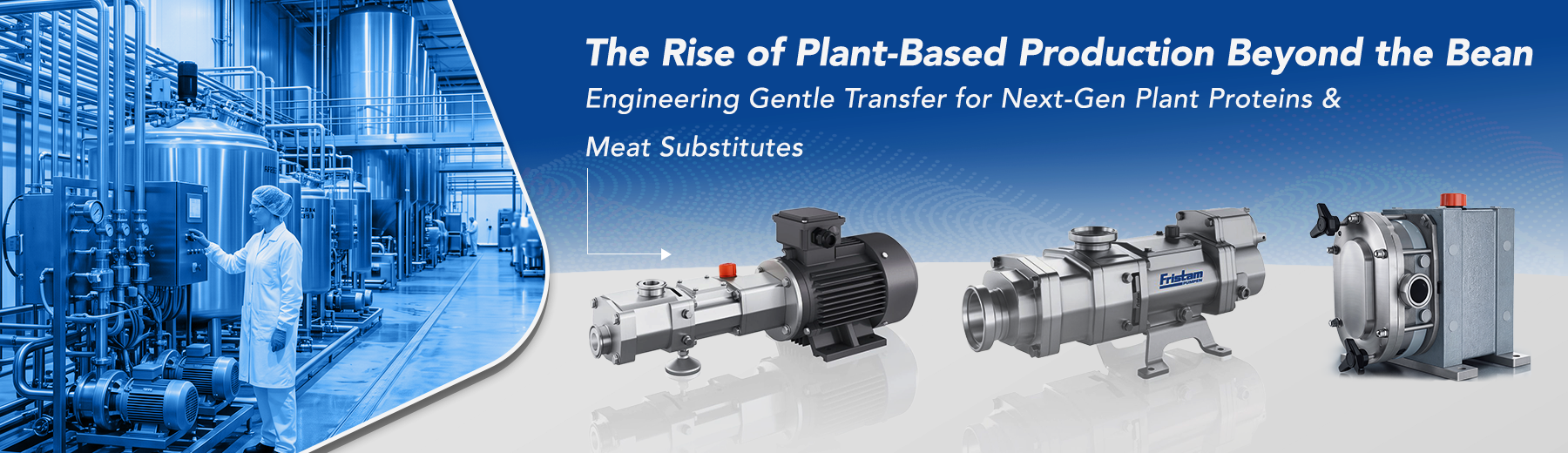
Turning plants into high-quality protein sounds straightforward until you're actually doing it. Soya beans, yellow peas, corn, chickpeas, all of these carry meaningful protein content. Getting that protein out cleanly, concentrating it, texturizing it, and moving it through a production line without destroying its value is something else entirely. Chemistry is one challenge, engineering is another. And in most plant-based facilities struggling to maintain product quality on a scale, the engineering side is where the real trouble lives.
Processing plant-based proteins efficiently is the real challenge the industry doesn't talk about enough. Transfer equipment gets overlooked until batches start coming out wrong, yields drop, or a CIP cycle fails a hygiene audit. The pump sitting between each process stage is doing more structural work than most production managers account for.
fristam changes how plant-based protein processing gets approached at the equipment level. From low shear food processing in texturization lines to high-volume extraction and thermal concentration, Fristam's pump and mixing solutions are built specifically around what plant-based protein production actually demands.
Why Plant-Based Ingredients Demand a Different Approach
Plant-based protein processing isn't a single workflow. It runs across multiple stages that each have completely different fluid behaviours and mechanical requirements. The four core processes that Fristam's equipment directly supports are wet milling, semi-solid handling,evaporation, and CIP return. Each one puts different demands on the pumps and mixers involved, and getting the equipment wrong at any of these stages costs yield, quality, or both.
Wet Milling Process
Wet milling is the primary extraction method used for extracting protein from crops such as soya, peas, corn, and legumes. The process involves soaking, grinding, and separating protein fractions from fibre and starch using water as the carrier medium. It generates slurries with varying viscosities, high powder-to-liquid mixing demands, and shear conditions that need to stay controlled to avoid denaturing protein during extraction.
This stage presents challenges like uneven dispersion, high mixing demands, and the risk of protein denaturation due to uncontrolled shear. Proteins don't dissolve cleanly into water. They clump, agglomerate, and create localised high-viscosity zones that conventional mixing equipment handles poorly. Food-grade pumps and mixing solutions at this stage need to create uniform dispersion without generating shear conditions that damage protein structure at the extraction point.
This stage presents challenges like uneven dispersion, high mixing demands, and the risk of protein denaturation due to uncontrolled shear.
Semi-Solid Process
Once protein is extracted and concentrated, it moves into texturisation. Texturized vegetable proteins, soy concentrates, pea protein gels, and meat analogues are all produced through semi-solid processing that handles pastes, gels, and high-viscosity slurries at various stages. This is where shear sensitivity becomes the primary engineering concern.
Twin screw pumps are built for exactly this. The intermeshing screw mechanism creates sealed axial chambers that carry product forward without metal-on-product contact. No crushing. No tearing of fibrous protein structures. For industrial pumps for viscous products moving semi-solid protein materials, this contact-free mechanism is what separates a pump that preserves product integrity from one that quietly degrades it batch after batch.
Evaporation
Evaporation is among the more technically complicated stages in plant-based protein production. Thermal evaporation systems concentrate protein liquids recovered from wet milling by removing water content to reach the protein percentages required downstream. Elevated temperatures and aggressive handling during this stage can denature proteins and reduce the solubility that makes concentrated protein useful in the next process step. The pump supporting the evaporation circuit needs to handle a gentle, consistent transfer that doesn't add mechanical stress on top of the thermal stress the product is already experiencing.
How Fristam Hygienic Pumps Improve Plant-Based Production: From Lab Scale to Commercial Line
Fristam doesn't offer a single-pump answer to plant-based protein processing. The equipment recommendation maps directly to the process stage and what that stage demands from the machinery involved.
For wet milling and extraction, Fristam provides the powder mixers PM/PMV for uniform protein-to-water dispersion, the Shear Pump FSP for controlled particle breakdown during dispersion, and the Screw Feeder paired with the FDS Twin Screw Pump for accurate, continuous feeding of viscous extraction slurries through the milling circuit.
For semi-solid processing and textured protein handling, Fristam provides the FKL Positive Displacement Pump and the FDS Twin Screw Pump as primary transfer solutions. The FKL handles high-viscosity concentrates and gels. The FDS manages denser, structurally complex slurries from textured vegetable protein and meat analogue production. Both pumps operate without generating the shear conditions that break down fibrous protein networks at this stage.
For evaporation and protein liquid concentration, Fristam's centrifugal pump range provides gentle, consistent product handling that supports the thermal concentration process without adding mechanical damage. Protein liquid moves through the evaporation circuit at controlled velocity, maintaining structural and functional quality as water content reduces.
Role of Low Shear Pumps in Food Innovation: Protecting the Integrity of Next-Gen Protein Structures
Low shear food processing and hygienic design are not separate conversations in a plant-based protein facility. Organic, high-protein materials left in pump dead zones or rough internal surfaces create contamination risks that are slow to appear and expensive to trace. Hygienic pump design is a baseline operational requirement in protein processing plants where microbial growth conditions are consistently favorable.
Clean-in-place (CIP) food systems in plant-based protein plants run through a defined sequence: pre-rinse removes bulk product residue, alkaline wash breaks down protein and fat deposits, intermediate rinse flushes alkaline chemistry, acid wash removes mineral scale, final rinse clears all chemistry, and sanitation completes the cycle before the next production run. Every pump on the line needs to support this full sequence without disassembly or cleaning, or bottlenecks and increased downtime result
The Fristam True self-priming centrifugal pump range FZ can continuously transport products containing large amounts of air and gas without becoming airlocked. Additionally, its reversible function evacuates the tank and lines completely, and its high suction capacity reduces the risk of contamination, making the pumping process more efficient.
For lines running multiple protein types across a single shift, clean changeover speed directly determines how many batches the facility completes in a working day. Its not just compliance. It's throughput.
Conclusion
The plant-based category isn't approaching a ceiling anytime soon. Precision-fermented proteins, algae-based formats, and next-generation mycoprotein products will continue raising the complexity of what manufacturers are expected to move through their lines at consistent quality. Pump selection made at the right stage of plant design, and made correctly, protects product integrity from the transfer point outward through every downstream step.
The Fristam Pumps range is engineered for exactly these demands. Dual-purpose, hygienic, low-shear, CIP-ready, and built to handle the full viscosity range that modern plant-based production actually runs.
Use the Fristam Pump Configurator to identify the right Pump for your specific process application and production volumes..