
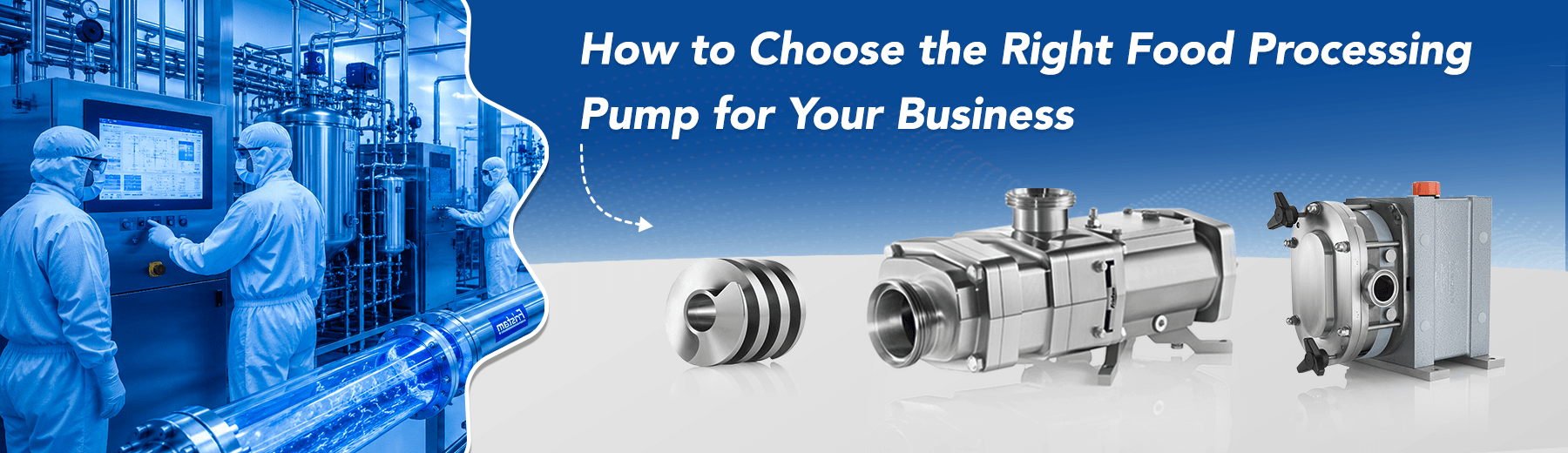
Choosing the wrong pump for a food processing environment creates problems that rarely stay small for very long. Failed CIP cleaning cycles, damaged product texture, unexpected maintenance shutdowns, and inconsistent transfer performance usually start showing up much faster than teams expect. Food production lines run under constant operational pressure, so the pump handling transfer or mixing duties need to perform reliably through every production shift without creating additional process instability.
Different food applications place very different demands on equipment, and certain pump technologies simply handle specific production conditions more effectively than others across long-term industrial use.
What Actually Makes a Pump "Food Grade"
In industrial manufacturing, the term 'food-grade pump' is often used. A stainless steel outer body alone does not make a pump suitable for hygienic food processing applications. The entire product contact path needs to minimise contamination risk during operation and cleaning cycles. That means
- polished internal surfaces,
- hygienic sealing systems,
- smooth flow geometry, and
- no hidden pockets where residue or bacteria can collect over time.
This is exactly why standards and certifications like FDA, 3A, and EHEDG matter so much inside food manufacturing environments. The tolerance for contamination problems is extremely low. Any industrial food pump under consideration should already meet those compliance requirements properly, not rely on later modifications or workaround adjustments after installation.
When selecting a hygienic pump for food production lines, don't rely only on specification sheets. Check how it handles cleaning cycles, how fast technicians can reach internal parts, and whether the seal setup truly simplifies maintenance during regular plant operation.
Twin Screw Pump Working Principle
A twin screw pump works by trapping fluid between two counter-rotating screws and moving it axially from suction to discharge. Unlike centrifugal pumps, there is no impeller, no high-velocity zone, no turbulence-induced shear.
This makes twin screw technology especially valuable when the product you're moving is delicate. Emulsions, sauces with particulates, dairy blends, fruit preps, viscous concentrates, and products that need to arrive at the next stage of the line looking exactly as they went in.
The Fristam FDS Double Screw Pump is built on this principle, refined and taken further. What Fristam calls a ground-up reassessment of twin screw technology resulted in the FDS addressing the common limitations of this pump category, specifically around temperature stability, maintenance access, and aseptic capability. The FDS runs at speeds up to 1,600 rpm and transports low-viscosity media like water or detergent solutions efficiently, making a secondary cleaning pump unnecessary for many lines.
FDS twin screw pump applications are broad. Beverage and brewing, food processing, and personal care products are all covered. The pump handles high and low viscosities, delivers incredible pressure and suction performance, and supports production and CIP in one unit. For a plant manager evaluating overall line efficiency, that consolidation of function matters more than most spec sheet numbers.
What Type of Pump Is Best for Viscous Food Products
For most hygienic rotary lobe pump alternative evaluations, this is where the Fristam FKL Positive Displacement Pump becomes highly relevant. The FKL series handles high differential pressure operations and is built around a perfectly balanced rotor design that minimises piston wear. Flow rates go up to 120 m3/h, discharge pressures up to 35 bar, and viscosities up to 1,000,000 mPa.s.
That viscosity ceiling is significant. Very few pump types can reliably handle products in that range without mechanical stress on the pump or product degradation. FKL pumps come in 10 different sizes and are suitable for both CIP and SIP applications. The split-style gearbox is worth noting specifically because it provides quick access to bearings and shafts, which reduces planned and unplanned downtime in ways that only maintenance engineers who have spent time on a floor will fully appreciate.
Here is a quick reference for matching pump type to product type:
Product Type | Viscosity Range | Recommended Pump |
Thin liquids, cleaning solutions | Low | FDS Twin Screw Pump |
Sauces, creams, pastes | Medium to high | FDS or FKL Positive Displacement |
Highly viscous products (gels) | Very high | FKL Positive Displacement Pump |
Powders requiring liquid integration | N/A | PM / PMV Powder Mixer |
Mixing Is Also Part of the Equation
Not every production challenge is a transfer problem. Sometimes the challenge is getting a dry ingredient into a liquid stream without clumping, without long dissolution times, and without the hygiene risks of open-air mixing.
The Fristam PM / PMV Powder Mixer addresses this directly. PM / PMV powder mixer specifications include
- 5 different sizes in the PM series and 3 in the PMV series, with powder intake up to 10 litres per hour.
- The mixer is supported by a self-priming centrifugal pump (PM series) or a positive displacement pump (PMV series), depending on the application.
- The powder is supplied from a funnel directly into the fluid product stream via an ergonomically designed table.
The FS Shear Blender uses intermeshing rotors and stators with a tight 0.5 mm gap. Rotating teeth whip past stationary ones at full speed. Centrifugal force slings the product straight toward the outlet. This chaotic motion locks in proper blending and particle dispersion.
For process engineers specifying a line from scratch, integrating a powder mixer with the right pump system eliminates manual handling steps that introduce contamination risk and slow throughput.
Key Pump Selection Criteria: What to Evaluate Before You Specify
Before finalising any pump for a food production line, the evaluation should cover at least these areas:
- Flow rate and pressure requirements: Check peak demand properly before sizing, oversized pumps create unnecessary load and inefficient operation.
- Product viscosity: Check for viscosity changes across operating temperatures, as fluids behave differently once process conditions shift.
- Shear sensitivity: Products containing emulsions or particulates need gentler movement, so twin screw pumps usually perform better.
- CIP/SIP compatibility: The pump should support cleaning-in-place without removal from the line. This is non-negotiable for most hygienic applications.
- Seal accessibility: Maintenance teams need to service seals without specialised tools or extended shutdown windows.
- Regulatory compliance: 3-A, FDA, or EHEDG certification, depending on the target market and product category.
- Total cost of ownership: The initial price is a single line item in the budget. Seal replacement frequency, downtime hours, and energy consumption are the others.
What Makes Fristam Pumps Stand Out
Fristam Pumps India has been providing food-grade twin screw pump solutions and hygienic pump technologies across industries where process integrity is not optional. The product range, from the FDS twin screw to the FKL positive displacement pump and the PM / PMV powder mixer, is built around the idea that the pump should never be the weak link in the line.
As a food-grade twin screw pump supplier operating in India, Fristam brings the same engineering standards that have made the brand trusted globally, with local support infrastructure for commissioning, after-sales service, and technical consultation. The pump configurator on Fristam's website allows plant teams to identify the right pump for their specific application without going back and forth on email chains.
Fristam's approach to pump design is not about adding features. It's about eliminating the problems that cause grief in the field.
Conclusion
Choosing the right pump for a food processing application is a decision with long downstream consequences. The wrong choice shows up in product quality issues, maintenance backlogs, compliance risks, and total cost of ownership figures that look bad at year-end review.
A hygienic pump food production line depends on equipment that performs consistently, cleans thoroughly, and stays serviceable over years of heavy use. The Fristam FDS, FKL, and PM / PMV mixer represent a coherent ecosystem of hygienic pump and mixing technology, designed to cover a broad range of food processing applications without compromise.
The right starting point is always understanding your product, your process parameters, and your compliance requirements. From there, the pump selection becomes significantly more straightforward.
Frequently Asked Questions
1. What factors should you consider when choosing the capacity of a food processing pump for your line?
Start with the required flow rate, operating pressure, and actual product viscosity during production conditions. Fristam configurator tools can help size the right pump more accurately.
2. How to maintain a positive displacement pump in a food plant?
Routine maintenance on the Fristam FKL pump stays fairly straightforward during regular service schedules. The split gearbox design gives faster internal access, so maintenance teams spend less time stopping and dismantling production equipment.
3. Are positive displacement pumps suitable for food with solid particles?
Positive displacement pumps manage suspended solids well when particle sizes stay controlled during transfer. Fristam FDS twin screw systems move delicate particulates gently, so products keep their texture intact without excess crushing or damage.
4. How does a twin screw pump protect shear-sensitive food products?
Twin screw pumps move products through smooth axial flow instead of aggressive spinning action. Dairy blends, emulsions, and protein drinks stay stable during transfer, while delicate textures pass through without noticeable separation or damage.