
Hygienic pumps used in food, beverage, and dairy processing are expected to perform consistently, dealing with changing temperatures, flow conditions, and demanding hygiene requirements. Often the first signs of pump cavitation affecting that performance are not obvious at once.
A change in noise, vibration or output can be an indicator of a problem developing that needs to be addressed. Detecting these changes early helps protect equipment, ensures smoother production, and reduces the risk of unnecessary downtime.
Now let’s understand what cavitation is in a hygienic pump, so you can recognise it early and respond with confidence.
What Is Cavitation In A Sanitary Pump?
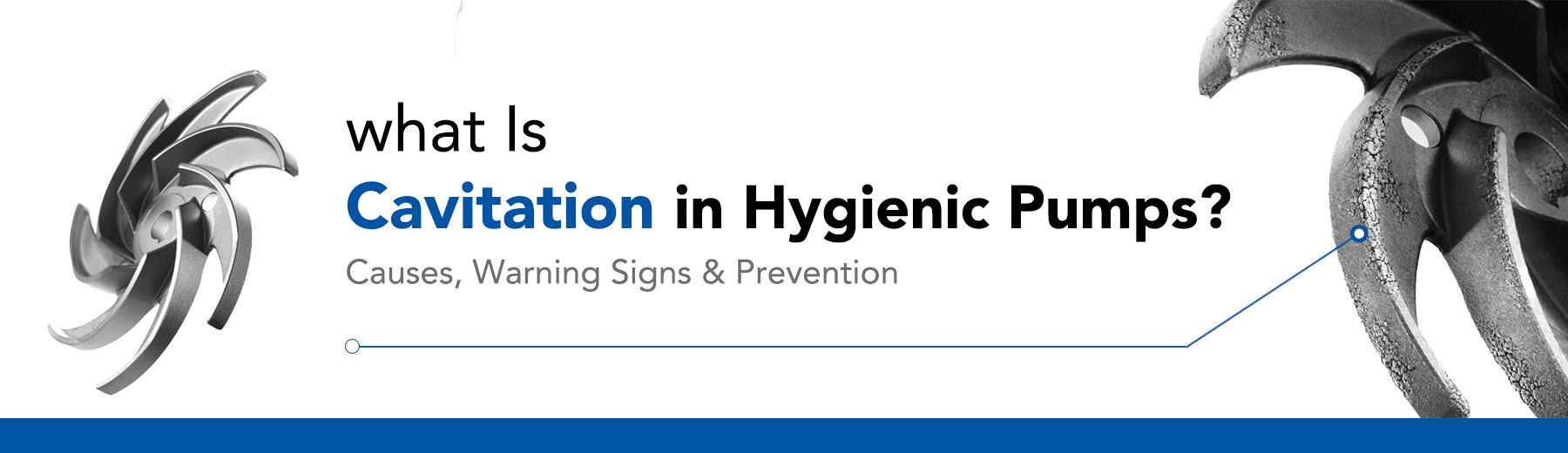
Sanitary pump cavitation occurs when the liquid pressure drops below the vapour pressure inside the pump, creating tiny vapour bubbles (usually at the impeller inlet). As the bubbles move into higher-pressure regions, they collapse rapidly, creating a series of shock waves in the pump. This can cause pitting and erosion of the impeller and other internal surfaces, reduced flow, efficiency and overall pump performance over time.
Causes of Pump Cavitation
Minor problems in different parts of the system can cause cavitation. It makes it easier to identify and correct the cause knowing what areas to check first:
- Pump inlet NPSH less than required. If the pressure falls below the vapour pressure of the liquid, then vapour bubbles may form if there is not enough Net Positive Suction Head available.
- Elevated product temperatures. The vapour pressure of a liquid increases with an increase in temperature. This can increase the likelihood of cavitation during hot-product transfer, pasteurisation or CIP (Clean-in-Place) cycles.
- Restrictions in suction lines. Pressure loss can occur before the liquid reaches the pump in undersized piping, blocked strainers, sharp bends, restrictive fittings, or partly closed valves.
- The operating conditions are unsteady. If the pump is operating too far from its Best Efficiency Point (BEP) this may interfere with flow and result in unstable pressure conditions that could increase the risk of cavitation. Low levels of vessel or air in the suction side can worsen the problem.
What Are the Early Signs of Pump Cavitation?
Not all pump problems start with an immediate drop in output. Often, small changes in how the pump behaves day to day are the most useful clue:
- Unusual rattling or crackling noises. A pump can make a sharp, gravelly noise when cavitation is occurring.
- Higher vibration levels. Any abrupt or increasing vibration may indicate unstable flow and pressure conditions surrounding the impeller.
- Loss of performance or loss of flow. If your pump is not running normally, with low efficiency, fluctuating pressure, or decreased capacity, cavitation may be to blame.
- Pitting and early wear. The repeated collapse of vapour bubbles if cavitation continues can damage the impeller surface and lead to faster wear of seals and bearings.
Why Hygienic Pump Cavitation Matters in Dairy and Food Processing?
In dairy and food processing applications, the same pump can be used for transfer, circulation, heating, cooling and cleaning. The temperatures, viscosities, flow demands and inlet conditions are different at each stage, so neglecting these changes can increase the risk of cavitation and affect the stability of the process.
- It can harm product-contact surfaces. In the pump, the vapour bubbles produced by cavitation move into the high-pressure regions, and they collapse over and over. This can result in the slow pitting and erosion of internal product-contacting surfaces, making them rougher over time.
- It can also be more hygienically difficult to clean. Pitted areas are more likely to retain product residues and make effective CIP or SIP cleaning more difficult to achieve.
- It affects the consistency of the process. Product transfer may become less smooth and operating conditions more unpredictable as flow and pressure vary.
- This may result in greater wear and tear and more downtime. If cavitation continues, it can add stress to the impeller, seals and bearings. That could mean more frequent maintenance and the risk of unplanned shutdowns.
How to Prevent Cavitation in Centrifugal Pumps?
The best way to prevent cavitation is to keep the pump in a stable operating environment with a constant supply of liquid. Sudden flow disturbances, air entry, and pressure drops can be reduced by a few regular checks:
- Properly prime the pump. Prior to starting, the casing and suction line must be filled completely with liquid with no trapped air.
- Never admit air to the suction side. Check for air leaks in connections, seals, and fittings. Maintain the liquid level in the supply vessel high enough to prevent air entrainment or vortexing.
- Revisit pump selection if the process changes. Changes in product viscosity, production capacity, or system layout can alter pump conditions.
- Avoid sudden changes in flow conditions. Fast valve action or sudden changes elsewhere in the process can upset the flow. Slow changes make liquids flow smoothly.
How Fristam Guarantees Reliable Hygienic Pump Performance?
At Fristam, we have developed FP centrifugal pumps specially for hygienic processing. Their flow-optimised channels and impeller vane angles help to keep NPSH requirements down, which can make pump selection easier in systems with demanding suction conditions. Our FP range is a practical choice for dairy, food, beverage and other hygienic applications and supports gentle product handling and CIP/SIP processes.
Where the process involves entrained air, poor suction conditions or CIP return, we also offer self-priming solutions. Our FZ liquid-ring pumps are designed for high suction capacity and can continuously handle liquids containing significant amounts of air or gas without becoming airlocked.
Unlike these, our FPC self-priming centrifugal pumps can reliably handle gaseous liquids, empty tanks, and support CIP return applications with a combination of a centrifugal impeller and a rotor screw. These options give you greater flexibility when the process conditions are not suited to a conventional flooded-suction centrifugal pump.
Note: Proper pump selection and system design are still critical to reliable operation. To minimise the risk of cavitation, the flow rate, product temperature, suction piping, inlet pressure and available NPSH must be considered together.
Keep Cavitation from Becoming a Bigger Process Problem
Pump cavitation is usually a sign that pressure, flow or suction conditions need attention. Recognising the signs of pump cavitation early and correcting the root cause can help protect pump components, reduce unplanned interruptions and support reliable hygienic processing. Knowing how to prevent pump cavitation also helps to maintain stable performance across demanding dairy, food and beverage applications.
For the right pump selection and support with challenging process conditions, you can explore Fristam’s pumps or speak with our team.
Frequently Asked Questions
1. What is cavitation in a sanitary pump?
This happens when the pressure of the liquid falls below its vapour pressure. Inside the pump, small vapour bubbles then form and collapse rapidly as they move into higher-pressure regions. Repeated bubble collapse can slowly damage the internal surfaces of the pump.
2. Why is cavitation a concern in dairy and food-processing applications?
Cavitation is an issue in the dairy and food processing industry as it can damage surfaces that come into contact with the product, make effective cleaning harder and affect equipment reliability.
3. What are the signs of cavitation in a pump?
Common symptoms are rattling noise, vibration, unstable flow or pressure, reduced capacity and impeller pitting.
4. How to avoid cavitation in centrifugal pumps?
Ensure adequate NPSH, minimise suction side restrictions, maintain product temperature within design limits, prevent air ingestion, and operate the pump near its BEP.