
Centrifugal Pump vs Positive Displacement Pump: Working, Benefits & Applications
September 1, 2026
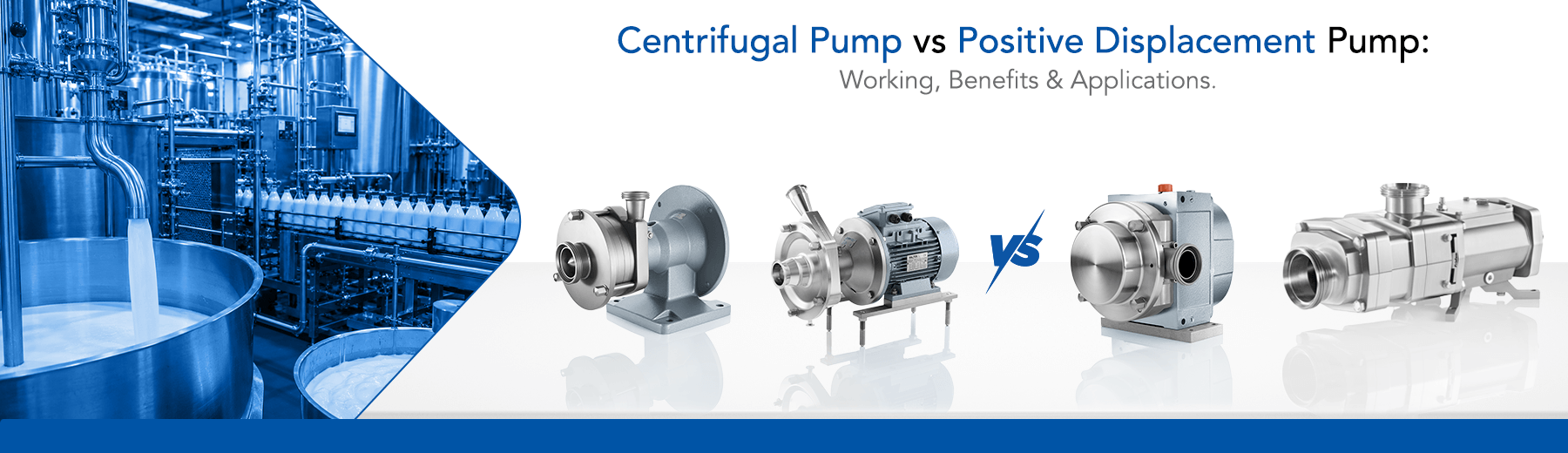
In hygienic processing, a pump does much more than move product from one place to another. Reliability of a pumping system over time can be affected by flow requirements, product consistency, pressure conditions and cleaning demands.
For food, dairy, beverage and pharmaceutical manufacturers, it is important to examine the pump technologies available to select one for a given process. Understanding what drives this decision is necessary to design a system that supports product quality and day-to-day consistency in operations.
Now let’s understand some basic centrifugal and positive displacement pump principles, so you can make a considered decision.
How Do the Two Pumping Principles Work?
A centrifugal pump uses a rotating impeller to move liquid. As the impeller spins, it adds speed to the liquid, and the pump casing then turns that movement into pressure. The result is a smooth and continuous flow, which is why centrifugal pumps are commonly used for lower-viscosity liquids and applications where larger flow rates are needed.
A positive displacement pump works in a different way. With each cycle, it moves a fixed volume of product from suction to discharge. Because the displaced volume is tied to pump speed, flow stays largely consistent even as discharge pressure varies within the pump's operating limits.
Centrifugal Pump vs Positive Displacement Pump: What Changes in Practice?
The difference between a positive displacement pump and a centrifugal pump becomes clearer when you look at how each responds to actual process conditions:
Parameters | Centrifugal Pump | Positive Displacement Pump |
Operating principle | Uses a rotating impeller to increase liquid velocity and convert it into flow and pressure. | Captures a fixed product volume and displaces it mechanically from suction to discharge. |
Flow behaviour | Varies with system resistance and differential pressure. | Maintains comparatively consistent flow based on pump speed and displacement. |
Pulsation | Delivers smooth, continuous flow with minimal pulsation. | Varies by design; rotary lobe and twin-screw pumps can provide low-pulsation flow. |
Viscosity of the product | Generally suited to low- and medium-viscosity liquids like milk. | Well suited to high-viscosity products like creams, syrups, sauces and pastes. |
Efficiency as viscosity rises | Shows lower efficiency, flow and head as hydraulic losses increase. | Gains volumetric efficiency as internal slip reduces, with mechanical and friction losses still relevant. |
Pressure conditions | Performs efficiently within the specified flow and pressure range. | Maintains flow more consistently as differential pressure changes, within operating limits. |
Handling of the product | Provides smooth flow, with higher speeds and turbulence potentially increasing shear. | Provides lower-shear transfer for viscous and sensitive products such as cream, yoghurt, cultured products and emulsions. |
Air handling and suction | Requires good inlet conditions in standard designs; self-priming versions can handle entrained air. | Provides stronger suction capability for more demanding inlet conditions. |
Common Applications | Handles liquid transfer, circulation, filtration, heat exchanger duties and Clean-in-Place (CIP) systems. | Handles viscous transfer, dosing, filling and processes requiring steady flow or gentle product handling. |
Pump sizing | Suits higher-flow duties involving free-flowing products. | Suits duties driven by viscosity, product sensitivity or changing pressure conditions. |
Where Centrifugal Pumps Perform Best
No two processing lines share the same product characteristics or operating requirements. Looking at these conditions in detail makes it easier to see where different pump technologies fit into the process:
- Ideal for low- to medium-viscosity products. Centrifugal pumps work best with liquids that can flow easily through the system like dairy products; milk.
- Suited to high, continuous flow duties. Centrifugal pumps give a smooth, continuous flow, and are particularly suitable where relatively large volumes of product need to be moved through a process efficiently.
- Adapt to different process roles. Different types of centrifugal pumps suit different duties. Fristam offers the FP for hygienic transfer, FM for high-head multistage applications, FPH for high-pressure duties, FPV for high-purity and WFI processes. FPC and FZ for true self-priming requirements.
- Fit into various stages of hygienic processing. Typical applications of centrifugal pumps are feeding heat exchangers and pasteurisers, membrane filtration, filling lines and Clean-in-Place (CIP) systems. Across dairy, food, beverage and pharmaceutical plants in India, they are commonly used where steady transfer of low- to medium-viscosity liquids is required between processing stages.
Where Positive Displacement Pumps Have the Advantage
The choice of a pump is closely related to the behaviour of a product in processing. Varying viscosity, pressure, flow and handling requirements can all impact what the system requires from the pump.- Greater support for accurate dosing and transfer. Better suited to precise flow control and dosing duties. Because a positive displacement pump moves a defined volume with each revolution, it can deliver a consistent, measurable flow where tighter control over product transfer is required.
- Handle products with soft solids or particulates. Properly designed rotary lobe pumps move these products with minimal damage to their structure.
- Allows operation at lower pump speeds. Positive displacement pumps can move product well in some sensitive processes without relying on the higher rotational speeds often associated with centrifugal pumping.
- Specialised designs offer greater process flexibility. Depending on the pump type, positive displacement technology can support reversible flow, product recovery or handling process media and cleaning liquids in the same production line.
How Fristam Matches the Pump to the Process
At Fristam, we design centrifugal pumps to match the process duty. Different pump ranges are suited to different operating requirements:- FK, FKL and FL/FL3 rotary lobe pumps: Suitable for the controlled, gentle transfer of high-viscosity products.
- FDS twin-screw range: Can handle both highly viscous products and low-viscosity CIP liquids. This allows the same pump to manage production and cleaning duties without the need for a separate CIP pump.
Choosing the Right Pump Starts With the Product and Process
No single pump technology can suit every hygienic application. The correct choice between a centrifugal pump and positive displacement pump depends on factors such as viscosity, flow, pressure, suction conditions, product sensitivity and cleaning requirements.
Speak with the Fristam team to evaluate your application requirements and identify the pump technology best suited to your process.
Frequently Asked Questions
1. What is the difference between a centrifugal pump and a positive displacement pump?A centrifugal pump creates flow by using the impeller to impart velocity to the liquid, which is then converted into pressure. Positive displacement pumps capture and move a set volume of liquid with each pumping cycle.
2. How does a centrifugal pump work?It uses a rotating impeller to increase the liquid’s velocity, which is then converted into pressure and continuous flow.
3. How does a positive displacement pump work?It displaces a fixed volume of product and moves it from the suction side to the discharge side.
4. Which is more efficient: centrifugal or positive displacement pumps?It depends on the application. Centrifugal pumps are usually better for high flow rates and low-viscosity liquids. Positive displacement pumps can be better with viscous products and changing pressure.
5. When to use a centrifugal pump?You should use a centrifugal pump for low-viscosity liquids, higher-flow applications and systems with suitable suction conditions.
6. When should you use a positive displacement pump?You should use it for viscous, shear-sensitive products or for applications where flow should remain relatively consistent as system pressure changes.