
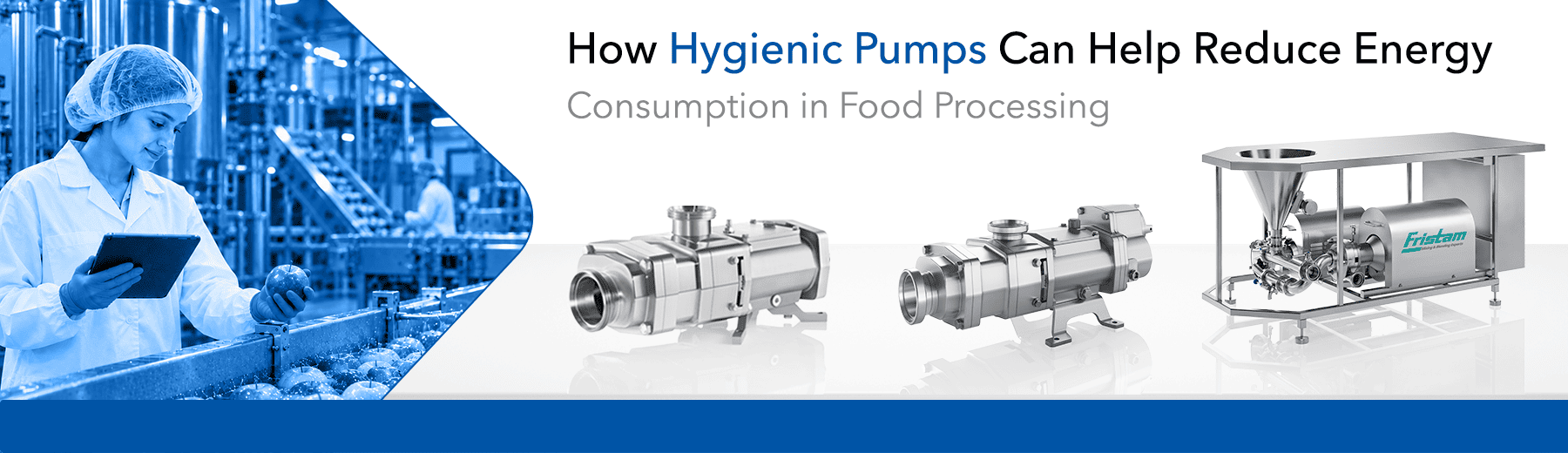
From raw ingredient transfers and liquid circulation to product mixing and equipment cleaning, food processing plants are dependent on pumps during production. Due to the different products and process requirements, the demands on a hygienic pump can vary considerably.
An important consideration in these operations is the consumption of energy, especially when equipment is in operation for long periods of time. As manufacturers seek to improve the efficiency of their production, it becomes increasingly important to understand where energy is used in the pumping and mixing processes.
Where Does Pumping Energy Go in Food Processing?
The pumping energy varies among food processing applications. Milk transfer, recirculation of cleaning solutions, and transfer of viscous products such as sauces all have different flow and pressure requirements. A hygienic pump must also work against resistance from the pipelines, valves, and other equipment along the process line, all of which adds to its overall power consumption.
Energy losses, however, are not always related to the product being handled. A pump selected for a much higher capacity than the process requires may operate away from its Best Efficiency Point (BEP), where it uses energy most effectively. Excessive pipeline resistance or unnecessary pressure can also increase the power needed to maintain the required flow, making the overall pumping system an important part of energy management.
Pump Efficiency Starts with Pump/Duty Matching
The need for pumping is not always the same during the production of food. Each stage has its own operating conditions to consider, from handling ingredients at different temperatures to handling cleaning cycles.
- Account for changes in product temperature. Heating or cooling can change a product’s viscosity, which may alter the flow behaviour and the load placed on the pump. This is especially relevant in processes where the product moves through different temperature stages during production.
- Check the pump suction requirement. Cavitation is more likely to occur when liquids are hot, suction lines are restricted, or inlet pressure is low. The system must provide enough NPSH available (NPSHa) above the pump’s NPSH required (NPSHr), considering such things as suction-line losses, static head, product temperature and vapour pressure.
- Think about the cleaning cycle. Production and CIP typically require different flow rates and speeds of operation. A pump capable of both duties can simplify the cleaning arrangement and do away with extra pumping equipment.
- Verify pump operating hours. A pump running full time through the production run will have a different energy profile than one running intermittently. Analysis of daily operating patterns can identify if a more efficient motor or appropriate speed-control system could result in reduced energy consumption over time.
Variable Speed Can Reduce Unneeded Pumping
You don’t always have to run a pump at full speed for the whole production run, especially in applications where flow requirements may change from one operation to the next. The speed of the pump motor can be controlled by means of a variable frequency drive (VFD) to match the process demand and maintain the required flow rate without running the process at full capacity.
This matters most in centrifugal applications that run for long hours. According to the pump affinity laws, the power required varies approximately as the cube of the pump speed. In practice, a 20% reduction in pump speed would theoretically lead to a ~49% reduction in power demand. Actual savings will vary with the system resistance, static head, pump efficiency and operating conditions, but variable-speed control can offer substantial energy savings where the process does not require full flow at all times.
How the FDS Twin Screw Pump Can Simplify Production and CIP
Food processing line conditions can differ based on the product being processed and the stage of production. These differences impose specific requirements on the internal parts of the pump, the flow pattern and the pump’ ability to maintain efficient operation.
- Defined clearances support efficient transfer. The FDS uses non-contacting twin screws with precisely controlled clearances between the screws and pump casing. This design helps limit internal leakage while allowing the pump to operate without the screws touching each other or the casing.
- The pitch of the screw will depend upon the application. The FDS is equipped with feed screws of different pitches to suit the specific operating conditions. By selecting a suitable screw design, the displacement characteristics of the pump can be adapted to the particular duty.
- Smooth flow means continuous transfer of products. FDS supplies a low-pulsation liquid to ensure a steady flow over the production line. This is particularly useful when feeding processing equipment that needs a steady feed of product.
- High shaft rigidity supports demanding pressure duties. The FDS uses a reinforced shaft design to maintain smooth, stable operation under elevated differential pressure. The added rigidity also helps keep operating temperatures lower when the pump is working under higher loads.
Mixing Efficiency Matters Just as Much as Pump Efficiency
The energy consumption of food processing is not limited to transferring products between different stages of production. Energy is also required in preparation of liquid mixtures, addition of powders and obtaining the desired product consistency. If powders are hard to dissolve or disperse, extra mixing and recirculation may be necessary, adding to the time and energy it takes to finish the process.
Fristam’s PM Powder Mixer combines powder intake, dissolving and homogenisation in one system. The PM has a self-priming FZ pump with a shear pump, while the PMV has a FL3 positive displacement pump for higher viscosities. With these functions, both systems can help manufacturers manage their mixing needs without having to use several separate pieces of equipment.
Lower Energy Use Also Depends on the Surrounding System
The energy required in production can be affected by the interaction of different components. In addition to pump selection and operating speed, careful attention to equipment coordination, product handling and routine maintenance can avoid unnecessary energy losses.
- Coordinate pumping with other processing equipment. Pumps should run in line with the needs of upstream and downstream equipment. This helps avoid unnecessary product movement or extended pump operation when the next stage of production is not ready.
- Keep air out of the product stream. Air entering the product intake or transfer may interfere with the smooth flow of liquid and result in a loss of pumping efficiency. Good tank arrangements and careful handling of the product will help maintain a steady supply to the pump.
- Keep flow paths free of build-up. Residue and deposits can form on product contact surfaces, especially with sticky or heat-sensitive ingredients. Good cleaning keeps the flow paths clear and doesn’t allow for the buildup of resistance over time.
- Service motor and mechanical parts. Mechanical losses can be increased by worn bearings, poor shaft alignment and insufficient lubrication. A well-maintained pump and drive system will run efficiently and without wasting energy.
What Should Food Processors Look at Before Upgrading a Pump?
An existing pump may continue to meet production targets but may consume more energy than necessary. By looking at its power consumption, operating condition and performance at different stages of processing, manufacturers can get a sense of whether it needs to be upgraded. While considering the suitability of the existing equipment, any changes in the production line should also be taken into account.
The next step is to compare the available alternatives with the actual operating requirements of the plant. Besides energy consumption, factors such as equipment durability, ease of maintenance and cleaning efficiency can also impact long-term costs. Thus, investment in energy-efficient hygienic pumps should be based on the anticipated improvements in pumping performance and in the day-to-day operating expenses.
How Fristam Supports More Energy-Efficient Processing
At Fristam, we match the pump or mixing system to the product, flow, pressure, viscosity and cleaning duty. Looking at production and CIP together can also help avoid unnecessary equipment or oversized drives.
- FDS Twin Screw Pump:Designed for both high- and low-viscosity products, the FDS can handle production and CIP duties through the same pump. Depending on the model, the FDS can operate at high rotational speeds for low-viscosity media such as water or cleaning solutions, allowing it to meet the higher flow requirements associated with CIP.
- FDS-TSG Twin Screw Pump: Its twin-speed gearbox supports low-speed production and higher-flow CIP duties. In a documented caramel application, the FDS-TSG handled the duty with an 11 kW motor instead of the 30 kW motor otherwise required, delivering a 45.6% energy saving during production, or around 10,134 kWh a year.
- PM Powder Mixer: Combines a self-priming FZ pump with a Fristam shear pump, drawing powder directly into the liquid stream before homogenising it. This brings powder intake and mixing together within one compact system.
- PMV Powder Mixer: Uses an FL3 positive displacement pump with a shear pump and is suited to more viscous mixing duties. The PM/PMV range supports powder intake rates of up to 10 t/h and is designed for both CIP and SIP.
Better Energy Use Starts with the Right Process Fit
Energy efficiency in food processing depends on how the entire pumping process is managed. Flow, pressure, viscosity, operating speed and cleaning requirements can all affect energy consumption.
The selection of the right hygienic pump for the application can help limit unnecessary power demand, while maintaining reliable process performance. Solutions such as the FDS twin screw pump and PM Powder Mixer also provide increased versatility across production, cleaning and mixing duties when used appropriately.
A detailed view of the whole process often helps to see where energy is being wasted and where the equipment choice can make a difference.
Talk to Fristam about your process needs for a matched pumping or mixing solution.
Frequently Asked Questions
1. How do hygienic pumps help in energy saving in food processing?A properly sized hygienic pump will only give the flow and pressure the process requires, thus avoiding wasted energy. Variable-speed operation and the right pump selection can also help to reduce energy consumption in food processing.
2. What type of pump design results in less energy consumption?A well-designed hydraulic system, a properly sized motor, variable speed capability and the ability to efficiently perform production and cleaning tasks can all help reduce energy consumption. These are important points to consider when choosing hygienic, energy-efficient pumps.
3. Which type of hygienic pump is most energy-efficient for food processing applications?There is no one type of pump that is most efficient for every duty. The right choice is based on viscosity, flow, pressure, temperature and CIP requirements. For example, an FDS twin screw pump can be used in applications where the same pump has to handle both viscous products and cleaning liquids.
4. Does the capacity or size of a pump impact the total energy consumption?Yes. An oversized pump can generate flow or pressure in excess of the needs of the process, and can consume more energy. Correct sizing is therefore very important in the selection of energy-saving pumps for the food industry.
5. Does an energy-efficient hygienic pump save money on long-term operation?Yes, provided the pump is correctly matched to the duty. Energy-efficient hygienic pumps can offer savings in the long term through lower power demand, improved speed control, easier cleaning and reduced maintenance.