
Role of Pumps in Biopharmaceutical Manufacturing: From Sterility to Process Consistency
May 5, 2026
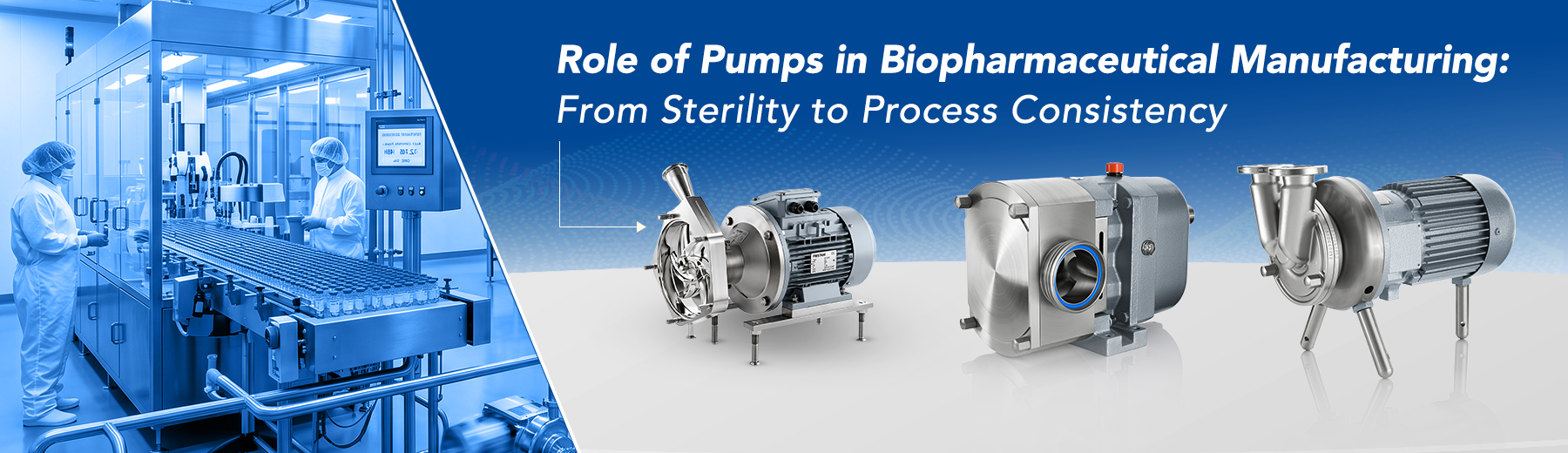
Biopharma manufacturing depends on extremely controlled process conditions across every production stage. Facilities move sensitive proteins, sterile fluids, and live biological material through shared systems continuously. In that environment, the pump is not passive equipment sitting in the background. Its performance directly affects product yield, contamination risk, and long-term compliance outcomes during regulatory audits.
Pumps for biopharmaceutical manufacturing do not get the same attention as upstream bioprocess design or downstream purification. But process engineers who have seen a scale-up go wrong due to an incorrect pump selection understand what is at stake. The batch does not fail because the pump breaks. It fails because the pump underperforms in a way nobody flagged during specification.
Why Pump Selection Shapes Process Outcomes
Most manufacturing industries can tolerate small process inconsistencies without major operational consequences. Biopharma works very differently from that. Minor pressure fluctuations or unstable flow conditions during production often create larger downstream issues that become difficult to identify and correct later.
The role of pumps in biopharmaceutical manufacturing goes beyond moving fluid from point A to point B. These pumps control shear exposure on fragile biologics, determine whether CIP cleaning cycles actually reach every surface, and define how consistently the process repeats across production runs. When a facility struggles with batch-to-batch variability, the pump specification is one of the first things worth reviewing.
Scale-up makes this more complicated. A pump configuration that performed reliably at 200L pilot scale can start behaving differently at 2,000L production volume, not because the flow rate changed but because its pulsation profile interacts with longer pipe runs and larger vessel geometries. Plant managers who have been through that situation once tend to be very particular about pump selection the next time.
Types of Pumps Used in Bioprocessing
The types of pumps used in bioprocessing are not interchangeable. Each category solves a different kind of problem, and using the wrong one creates a different kind of problem in its place.
Here is where most biopharma facilities land across the process:
- Positive displacement pumps handle precise, low-shear transfer of delicate fluids, cell broths, protein intermediates, viscous biologics, where shear damage to the product is a real concern and fixed-volume delivery matters for process repeatability
Centrifugal pumps are used in high-flow, high-pressure applications like Water for Injection loops, buffer tanks, and CIP supply lines, where sterility and traceability are the primary requirements
- Liquid ring self-priming pumps are built for CIP return lines and high-gas-content liquids where conventional pump designs lose suction, a gap that shows up more than facilities expect during drainage and changeover cycles
How Biopharma Pumps Handle Sterility
High-pressure pharmaceutical applications put specific demands on centrifugal pump design, and Fristam's FPV centrifugal pump with WFI (water for injection) series was built specifically for this environment, and the design reflects that.
The FPV Pump with C-Cooling uses a pressurised double-seal flush system that keeps positive pressure in the critical seal area. This actively prevents product contamination and stops process fluid from migrating into the seal. The front seal face design reduces product waste through a recirculation loop, and Fristam's internal tracking system maintains complete material provenance for every component used in every pump. As we comply with all standards and certification including ASME BPE (bioprocessing equipment) certification, GMP audits or FDA inspections, that level of documentation and standards are not a differentiator. It is a requirement.
The FPV Centrifugal Pump is available in 14 sizes, handles flow rates up to 550 m3/h, discharge pressures up to 15 bar, and viscosities up to 800 mPa.s. It is exclusively applied in bio-pharmaceutical settings, which says something about how purpose-specific the design actually is.
Right Pump for CIP (clean in place) and High-Gas Applications
CIP return lines and tank drainage present a different challenge. When the gas content in the liquid rises, conventional pumps lose suction. This is a common situation during drainage and CIP cycles that facilities either design around or deal with repeatedly as a maintenance issue. Fristam's FZ liquid ring true self-priming pump design was built for this. It operates on a side-channel principle with hydrodynamically optimised impellers and narrow sealing gaps that maintain suction even at high gas content. Six sizes, system pressures up to 15 bar, discharge up to 7 bar, viscosities up to 5,000 mPa.s, and a symmetric design that allows rotation reversal for bidirectional CIP circuits.
A hygienic pump manufacturer's biopharma procurement team should evaluate needs to solve for sterility and operational flexibility across different process stages. The FPV centrifugal pump with WFI and the FZ true self priming pump each solve a distinct piece of that problem.
Protecting the Product During Transfer
Moving sensitive biopharma materials through a process line involves much more than simple fluid transfer. Live cell suspensions and monoclonal antibody intermediates react differently to shear stress, pulsation, and unstable flow conditions during handling. The pump directly influences what reaches the next production stage and in what condition.
This is where Fristam FL and FL3 positive displacement pumps in biopharma become process-critical equipment. Their helical three-wing rotor design keeps pulsation extremely low while reducing product stress during movement. The pumps also support high viscosity applications and operate across demanding pressure ranges.
The compact structure improves CIP cleaning efficiency, too. Bidirectional rotation allows loading, unloading, and cleaning operations through the same unit, which reduces additional hardware requirements across biopharma production environments.
Pump Type and Biopharma Application
Pump Type | Where It Fits in Biopharma | Key Specs | Fristam Model |
Positive Displacement (Rotary Lobe) | Cell broth transfer, protein handling, viscous biologics | Up to 1,000,000 mPa.s viscosity, no pulsation, low shear | FL / FL3 Series |
Centrifugal (High-Purity) | WFI loops, sterile injectables, buffer transfer | Up to 550 m3/h, 15 bar discharge, full traceability | FPV Centrifugal Pump |
Liquid Ring Self-Priming | CIP return lines, high-gas-content liquids, tank drainage | Up to 80 m3/h, handles high gas content, reversible rotation | FZ Liquid Ring Pump |
Most facilities use all three categories across different stages of the same manufacturing process.
Fristam in Biopharmaceutical Applications
There is a practical difference between a pump that meets hygienic certifications and a pump designed from the start with hygienic processing as the core constraint. Fristam operates in the second category.
Material provenance, supplier quality documentation, process standards & biopharma certifications and per-unit component tracking, this is what makes Fristam a hygienic pump manufacturer that biopharma facilities can rely on during regulatory review, not just during normal operation. That kind of traceability reduces the investigative burden when something in a production batch needs to be traced back to equipment or materials.
The portfolio covers requirements from small-batch R&D scale through full production volume using consistent mechanical principles. That matters most during scale-up, where process behaviour needs to be predictable even as system geometry and fluid volumes change significantly.
Conclusion
Getting pump selection right in biopharma is not a procurement task that can be compressed into a spec sheet comparison. It determines how stable the process is across production runs, how well the facility holds up during audits, and how reliably scale-up translates from pilot to production. The types of pumps used in bioprocessing, positive displacement, centrifugal, and liquid ring true self priming pumps, each carry a specific set of responsibilities within the manufacturing system.
The role of pumps in biopharmaceutical manufacturing is most visible when something goes wrong. But the more useful frame is what goes right when the selection is accurate: consistent shear exposure, clean CIP cycles, sterile loops that stay sterile, and batch results that reproduce. That outcome starts with the pump specification, and it continues with the manufacturer behind it.
Frequently Asked Questions
1. How to maintain process consistency with positive displacement pumps in biopharma?
Positive displacement pumps maintain a steady flow rate even when the downstream system pressure changes during operation. That consistency matters in processes where repeatability affects overall product quality. Regular CIP cleaning schedules and rotor inspections also help preserve internal geometry properly, preventing gradual flow drift and performance variation from developing over longer production cycles.
2. How do liquid ring pumps prevent cross-contamination in pharma?
Liquid ring pumps handle high gas content fluids and CIP return applications more effectively than many conventional pump configurations. The Fristam FZ liquid ring pump supports self-priming, full drainage, and flow reversal, which helps improve cleaning coverage and reduces residue buildup between product changeovers inside process lines
3. What viscosity range can a positive displacement pump handle?
Fristam's FL/FL3 series handles viscosities up to 1,000,000 mPa.s, which covers the full range from low-viscosity cell broths to highly viscous biological intermediates and concentrated protein formulations that would stall or damage other pump types.
4. What pump is best suited for transferring monoclonal antibodies or live cell cultures?
Rotary lobe positive displacement pumps work well in biopharma applications, handling fragile biological material and sensitive fluid transfer conditions. The FL and FL3 series maintain smooth, low shear flow during operation, helping protect protein structures and live cell viability from unnecessary mechanical stress inside the process line.
5. How do biopharma facilities validate pump performance for GMP compliance?
Validation processes usually include installation, operational, and performance qualification stages under controlled production conditions. Documentation confirms that the pump maintains expected flow, pressure, and cleaning consistency during operation. Fristam also provides detailed material traceability and component records, which help facilities meet FDA and GMP audit documentation requirements more reliably.