
The Role of Hygienic Pumping in Modern Chocolate and Confectionery Processing
October 26, 2026
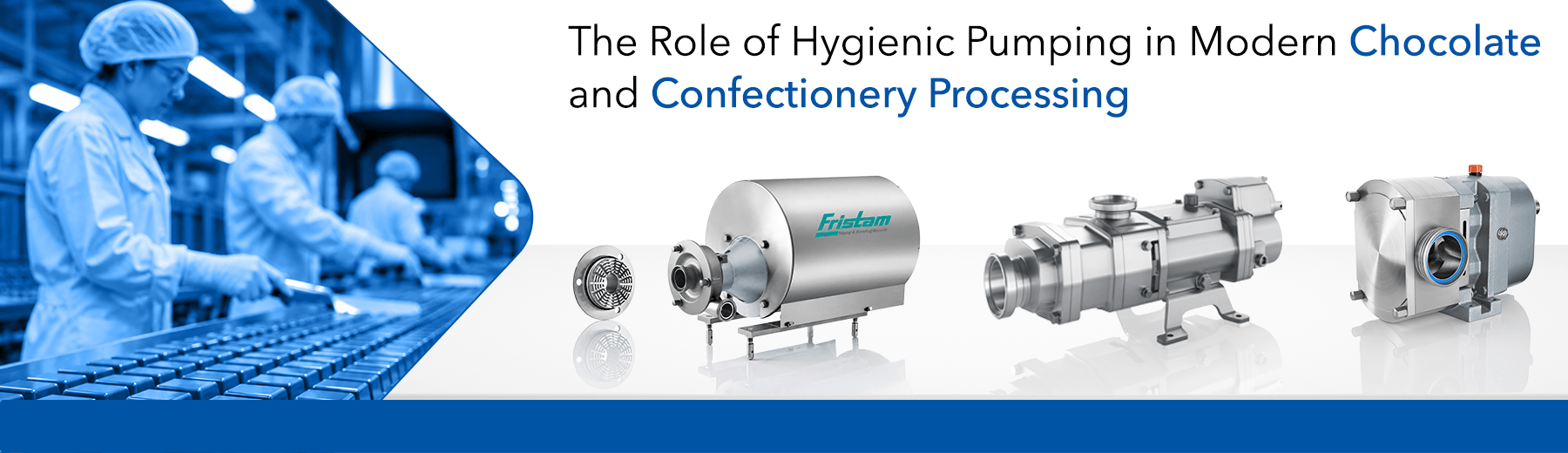
Few confectionery products behave the same during processing. Chocolate can become thicker as temperatures change, powders need to be incorporated evenly, and products such as caramel, fillings and pastes can place very different demands on processing equipment.
These conditions are common across the food and beverage processing industry, where product quality and clean processing have to be considered together. Selecting a hygienic pump therefore begins with understanding the product itself, how it needs to move and the conditions it will encounter along the production line.
Why Hygienic Pumping Matters in Chocolate Processing
Chocolate processing blends ingredients with very different characteristics, from fine powders and fats to syrups, fillings and thicker pastes. As these products move through production, their behaviour can also change with temperature and formulation.
- Cleanable product-contact surfaces. Hygienic design and smooth interior surfaces reduce the areas in the pump where chocolate, sugar or fat residues could remain.
- Lower cross-contamination risk. Good cleaning is especially important when using different recipes, flavours or ingredients that contain allergens. A hygienic pump must be capable of being thoroughly cleaned between production runs.
- Cleaning method shapes pump selection. Water makes chocolate seize, so many confectionery lines clean dry or flush with fat rather than running aqueous CIP. Wet CIP still applies to syrups, fillings and water-based components, where CIP-compatible pumps let cleaning solutions circulate without regular dismantling. The pump should suit the regime the line actually runs.
- Recognised hygienic design standards. The use of 316L stainless steel material grade, even more; special MOC like Hastelloy and Titanium. etc and design principles based on standards such as 3-A and EHEDG help to maintain hygiene standards in the food service industry.
Chocolate Brings More Than One Pumping Challenge
Chocolate does not behave the same way at every stage of production. A warm liquid mixture, a thicker filling and a dense confectionery paste can each pass through the same plant under very different processing conditions.
- Viscosity can change with temperature. As chocolate cools, its viscosity rises, and it becomes harder to move. Below working temperature, it begins to set, so the product path needs to stay warm throughout, including pump heads, seal areas and any section where flow pauses.
- Blending and transfer call for different shear. Cocoa, sugar and other ingredients need stronger shear during dispersion, while finished chocolate or delicate fillings often benefit from gentler transfer.
- Consistent flow becomes harder with thicker products. Dense chocolate, caramel and paste-like products place greater resistance on the pumping system. Maintaining a steady flow means considering viscosity, required flow rate and pressure together rather than looking at capacity alone.
- Suction conditions matter as much as discharge. Poor inlet conditions or excessive resistance in the suction line can affect performance, which is why pump selection and pipework design need to be considered together.
Where the Shear Pump Fits Into Chocolate Blending
A shear pump becomes useful when chocolate ingredients need more than simple circulation. Cocoa and sugar have to be dispersed properly into fats and liquids so they don't remain unevenly distributed through the mixture.
Fristam's FSP uses a rotor-and-stator system, drawing product through shearing clearances of just 0.3 mm at tip speeds up to 38 m/s, to break down agglomerates and improve ingredient distribution during continuous processing. With shear rates up to 125,000 1/s and viscosities up to 100,000 mPa.s, it suits demanding chocolate and confectionery applications where dispersion is central to the process.
Shear is valuable in the right place. Upstream, it produces a uniform blend. After tempering, it works against you, since excess shear and the heat it generates disturb the crystal structure that gives finished chocolate its snap and gloss. High shear for dispersion and gentle transfer afterwards, which is why one pump type rarely serves a whole confectionery line and in special cases recommendation meets with special duplex MOC high shear pump with diffusion hardening to get homogeneous repetitive output.
Moving Thick Chocolate Without Compromising the Product
Thick chocolate, caramel, fillings and confectionery pastes need a sanitary pump that can maintain steady movement without putting unnecessary stress on the product. Fristam’s FDS twin-screw pumps are designed for both low- and high-viscosity products, while the FDS-TSG Twin speed gearbox is particularly suited to demanding products such as candy paste. Their smooth, low-pulsation flow makes them useful where consistent transfer is important.
For applications that need gentle handling across a wide viscosity range, Fristam’s FL and FL3 rotary lobe pumps provide another option. Selected configurations can handle viscosities of up to 1,000,000 mPa.s, making them suitable for dense confectionery products where controlled transfer matters just as much as moving the product from one stage to the next.
Hygiene Standards Need to Extend Through the Pump
Meeting the food hygiene industry's expectations is not only about how equipment is cleaned. In chocolate and confectionery production, smaller design and operating details can also influence how well the pump fits into a controlled food-processing environment.
- Pay attention to sealing arrangements. The configuration needs to suit the product, operating temperature and process conditions so the product path remains properly contained during operation.
- Consider elastomers as part of product compatibility. Gaskets and other elastomer components come into direct contact with the process. Their suitability should be assessed against ingredients, temperature and cleaning media rather than treated as a secondary equipment detail.
- Look at drainability after the process stops. Product or cleaning liquid should not remain unnecessarily inside the pump after a cycle. Good drainability can be especially relevant where frequent recipe changes or tightly controlled production in food industries are involved.
- Keep compliance documentation in view. Hygienic processing also depends on being able to demonstrate that equipment is suitable for its intended food application. Relevant material information, certificates and recognised hygienic-design documentation can support plant qualification and internal food-safety procedures.
How Fristam Supports Chocolate and Confectionery Processing
At Fristam, we match the pumping technology to the product and process duty. Viscosity, product texture, shear requirements, flow and cleaning conditions all influence selection.
- FSP shear pumps: Designed for dispersion and emulsification where consistent blending is important. The rotor-stator system delivers shear rates of up to 125,000 1/s and can handle viscosities up to 100,000 mPa.s.
- FDS-TSG twin-screw pumps: Suited to transferring highly viscous confectionery products such as candy paste. Their broad speed range also allows the same pump to handle the higher flow rates required for CIP liquids, where wet cleaning is used.
- FL/FL3 rotary lobe pumps: Built for gentle positive-displacement transfer across a wide viscosity range up to 1,000,000 mPa.s. The FL3 uses helical three-wing rotors for smooth flow and is designed to operate at higher speeds during CIP return.
All Fristam pumps are designed for cleanability as well as production performance. CIP-capable configurations help chocolate and confectionery manufacturers move from product handling to cleaning without treating the two as separate process requirements.
Hygienic Pumping Supports the Whole Chocolate Process
Chocolate and confectionery processing calls for different pumping approaches at different stages. High shear may be useful when ingredients need effective dispersion, while viscous finished products require controlled and gentle transfer.
At Fristam, our hygienic pump range allows the pumping technology to be matched more closely to the application, whether the duty involves blending, transferring thick confectionery products or supporting CIP.
Speak with our team to identify the right pumping solution for your process requirements.
Frequently Asked Questions
1. Why is hygienic pumping important in chocolate and confectionery processing?
A hygienic pump supports clean product transfer while helping control contamination, maintain product quality and meet expected hygiene standards in food industry processing.
2. What type of pump is best suited for chocolate and confectionery processing?It depends on the process duty. A shear pump can support blending and dispersion, while twin-screw and rotary lobe pumps in food industry applications are often suited to handling viscous products.
3. How does a shear pump improve chocolate blending?A shear pump applies controlled high shear to disperse cocoa, sugar, fats and other ingredients more evenly, helping achieve a consistent mixture during food and beverage processing industry operations.
4. Can hygienic pumps handle high-viscosity chocolate and paste products?Yes. Hygienic twin-screw and positive-displacement pumps can handle thick chocolate, fillings and paste-like products when correctly selected for viscosity, flow and process conditions. This makes them particularly useful across the food and beverage industry.
5. What hygiene standards should confectionery pumps comply with?Confectionery pumps should meet applicable food-safety services and hygienic-equipment requirements. Standards such as 3-A and EHEDG provide recognised guidance for hygienic design and cleanability, both of which support safety in food industry processing.