
Twin Screw Pump vs Positive Displacement Pump: Key Differences & How to Choose
October 26, 2026
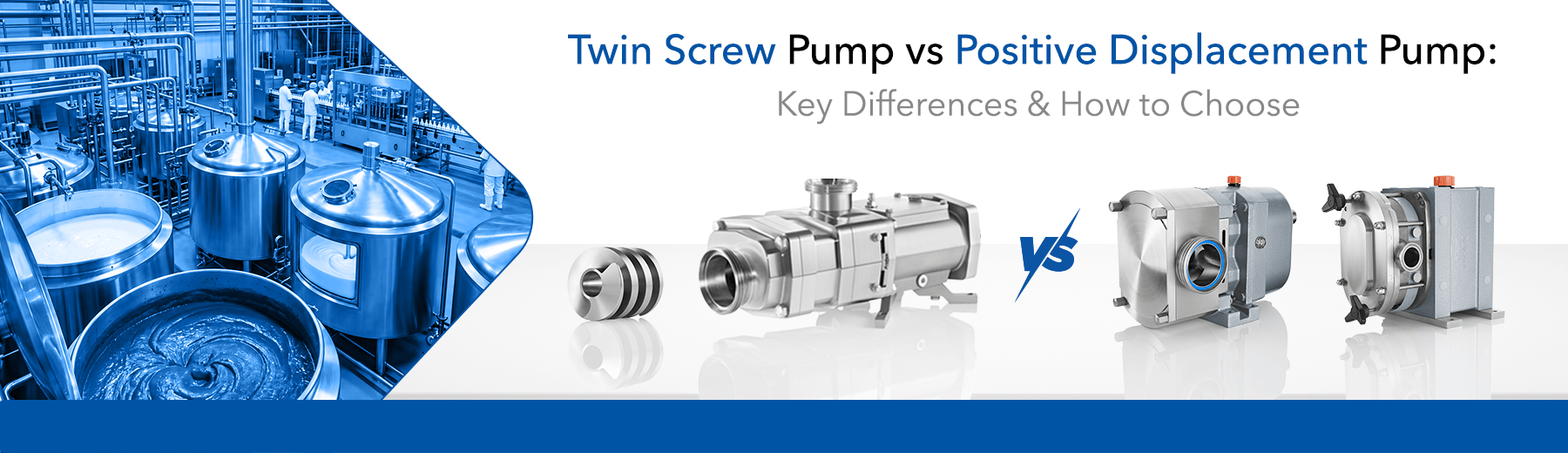
The product moving through a processing line can change the demands placed on the pump considerably. Viscosity may rise, air may enter the flow, or a sensitive texture may need to reach the next stage without unnecessary disturbance. Then, when production ends, the same line may have to deal with low-viscosity cleaning fluids.
These differences are worth considering before narrowing down a pump type. A closer look at the twin screw pump vs positive displacement pump discussion means considering not only how each design works, but also how well it fits the conditions found across the process.
Where Does a Twin Screw Pump Fit?
A positive displacement pump works by trapping and moving a defined volume of product and moving it from the inlet towards the discharge. This makes the technology particularly useful where consistent flow is needed with viscous or sensitive products. Within hygienic processing, positive displacement pumps can take several forms depending on how that product is moved through the pump.
A twin screw pump belongs to this same family. Instead of using lobes or other rotating displacement elements, it uses two intermeshing screws to move the product axially through the pump. For a useful sanitary pump comparison, it therefore makes more sense to look at twin screw technology alongside other positive displacement designs used for similar hygienic applications.
Twin Screw Pump vs Positive Displacement Pump: Where the Real Differences Begin
A better comparison is with other PD designs routinely used in hygienic processing, such as rotary lobe and circumferential-piston pumps, since the twin screw pump is a positive displacement pump in its own right. The differences are more noticeable when you see how each one deals with product, pressure, air and cleaning conditions.
Point of Comparison | Twin Screw Pump | Other Positive Displacement Pumps |
Product movement | Moves product axially through intermeshing screws. | Uses rotating lobes or pistons to displace product. |
Viscosity range | Handles low to highly viscous products. | Also highly effective with viscous products. |
Flow and pulsation | Provides smooth, very low-pulsation flow. | Can also achieve very low pulsation, depending on design. |
Entrained air | FDS handles significant entrained air effectively. | Capability varies with pump design and operating conditions. |
Production and CIP | FDS can handle both product and CIP duties. | Some designs, such as FL3, can also perform both duties. |
Product handling | Gentle, low-shear transfer suits sensitive products. | Many rotary PD designs also provide gentle product handling. |
Pressure duties | FDS reaches up to 25 bar, depending on model. | Certain designs reach higher pressures; FKL goes up to 35 bar. |
Where Twin Screw Technology Gives You More Flexibility
A process does not always run under one fixed set of conditions. Product viscosity can change, air can enter the line, and cleaning may require the same pump to handle a much thinner liquid. This wider operating range is where a twin screw pump can bring useful flexibility.
- Handles a wide range of viscosities. The FDS series pump can move thick products as well as much thinner liquids, which can be useful when different products or process stages share the same line.
- Supports both production and CIP duties. The pump can transfer viscous product during production and then operate at higher speeds with low-viscosity CIP fluids. In suitable systems, this can reduce the need for a separate CIP return pump.
- Keeps working when air enters the flow. Entrained air or intermittent gas does not always mean the process has to stop. The FDS is designed to handle these changing conditions, making it useful for aerated products and lines where air can enter during transfer.
- Moves sensitive products with less disturbance. Smooth, low-pulsation flow helps limit unnecessary shear, which can matter when handling creams, yoghurt, sauces, emulsions or products containing delicate inclusions.
Where Other Positive Displacement Pumps Still Make More Sense
Twin screw technology brings useful flexibility, but that wider operating range is not necessary for every process. In some applications, another positive displacement pump may suit the product and duty conditions just as well, or better.
- Very high viscosity can favour a dedicated PD design. Fristam’s FK and FKL pumps are built for difficult, highly viscous products. The FKL series pump can handle viscosities up to 1,000,000 mPa·s, making it well suited to demanding transfer duties
- Higher-pressure duties may call for a different approach. Where the process places greater emphasis on discharge pressure, pumps such as the FKL can handle pressures up to 35 bar, giving them a clear place in more demanding applications
- Stable product conditions do not always need a wider operating range. If viscosity, flow and product characteristics remain fairly consistent, another PD pump may provide everything the process requires without the added flexibility of twin screw technology
- Not every line needs one pump for both product and CIP. The ability of a twin screw pump to handle thick product and low-viscosity cleaning fluid can be valuable, but if CIP is handled separately, that advantage may be less important to the final pump choice
Sanitary Pump Comparison: What Should Guide the Choice?
A pump can look suitable on paper and still be the wrong fit once actual process conditions come into play. A useful sanitary pump comparison should therefore look at how the product behaves, what the line demands and how much those conditions are likely to change over time.
- Look at the product first. Viscosity, shear sensitivity, soft solids and entrained air can all influence pump selection. A product that needs gentle handling may place very different demands on the pump than a uniform, free-flowing liquid.
- Match the pump to the real duty point. Required flow, discharge pressure and suction conditions should be considered together. Selecting a positive displacement pump only by category can overlook what the process actually needs at the operating point.
- Factor in how much the process changes. If the same line handles products with very different viscosities, intermittent air or frequent changeovers, a twin screw pump may offer useful operating flexibility. More stable duties may not need such a wide operating range.
- Keep cleaning requirements in the picture. Hygienic design, CIP duties and whether the production pump also needs to move cleaning fluids can affect the final choice. The right pump should suit both production and the way the line is cleaned.
How Fristam Matches the Pump to the Process
At Fristam, we match the pump to the actual process duty. Product behaviour, operating conditions, cleaning requirements and the flexibility expected from the line all help determine which design fits best.
- FDS twin screw pumps: A strong fit for processes where conditions change. The FDS can move viscous product, handle entrained air and run at higher speeds with low-viscosity CIP fluids, allowing one pump to cover a wider operating range.
- FL/FL3 positive displacement pumps: Suited to products that need careful handling. The FL offers rotor options for soft or sensitive solids, while the FL3 uses a helical three-wing rotor to provide smooth, low-pulsation transfer.
- FK positive displacement pumps: Designed for compact, demanding duties where higher discharge pressure is required. The FK can operate at pressures up to 20 bar and flow rates up to 25 m³/h.
- FKL positive displacement pumps: Intended for applications that need greater capacity at demanding pressures. The FKL reaches discharge pressures up to 35 bar and flow rates up to 120 m³/h.
The Right Pump Comes Down to the Process
There is no single positive displacement pump that suits every hygienic application. A twin screw pump can bring greater flexibility when viscosity changes, air enters the product stream or the same pump needs to support both production and CIP. Other positive displacement designs can remain the better fit for stable, highly viscous or demanding pressure duties.
At Fristam, we look at the complete process before recommending a pump. Product characteristics, required flow, pressure, suction conditions and cleaning requirements all matter.
Frequently Asked Questions
1. Is a twin screw pump a type of positive displacement pump?Yes. It is a rotary positive displacement pump that uses two screws to move product through the pump.
2. What's the main difference between a twin screw pump and other positive displacement pumps?The main difference is the pumping geometry. Twin screws move product axially, while other designs use different rotating displacement elements.
3. Which handles high-viscosity fluids better — twin screw or other PD pumps?Both can handle very viscous products. The better choice depends on pressure, viscosity range, product sensitivity and process flexibility.
4. Do twin screw pumps handle multiphase flow better than other PD pumps?They are particularly well suited to entrained air or gas because they can maintain pumping through changing liquid-gas conditions.
5. Which pump type offers smoother, low-pulsation flow?Twin screw pumps can provide smoother, lower-pulsation flow because the product moves continuously along the screw channels.