
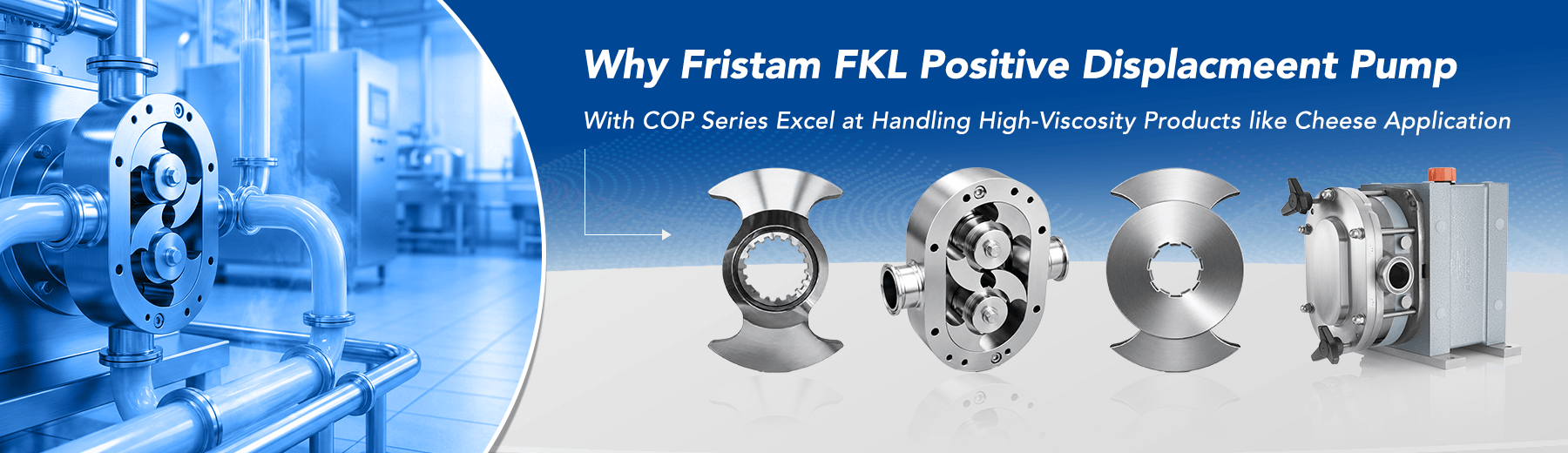
Why Fristam FKL Positive Displacement Pump with COP (Clean out of Place) series Excel at Handling High-Viscosity Products like Cheese Application
July 22, 2026
Cheese is one of the hardest dairy products to move consistently through industrial pumping systems. It stretches, sticks, and changes viscosity quickly depending on temperature and formulation during production itself. Pumps designed for lighter dairy liquids usually struggle badly here. Some damage the product texture through excess shear, while others lose stable flow completely once thicker cheese blends start moving through the line.
That's the exact problem a positive displacement pump for high viscosity dairy applications is built to solve. And within that category, the Fristam FKL positive displacement pump has established a strong track record in cheese processing lines globally, including in India.
How Does a Positive Displacement Pump Handle High Viscosity Fluids
This part matters more than many processing teams realise during equipment selection stages. Centrifugal pumps work by spinning an impeller fast enough to create flow through kinetic force. That setup handles thinner liquids reasonably well. Once viscosity starts increasing, though, efficiency falls quickly, and flow stability becomes inconsistent. Thick cheese products push that limitation even harder during production.
Positive displacement pumps operate differently. Instead of depending on velocity conversion, they trap fixed product volumes and move them forward steadily through rotating chambers. That makes them much more stable for sticky, resistant dairy products moving under changing process conditions.
The FKL lobe pump uses a circumferential piston mechanism built specifically for gentler high-viscosity transfer applications. Balanced rotors move inside a closely machined housing while maintaining controlled internal clearances. The product moves smoothly without aggressive metal contact or excessive structural damage.
At higher viscosities, slip drops almost completely, and flow behaviour becomes much more predictable. For cheese processing lines handling thick blends or processed sauces, this consistency supports cleaner dosing control, steadier throughput, and fewer production disruptions across longer operating cycles.
FKL COP (Clean out of place) Positive Displacement Pump Series: Built for Daily Teardown in Cheese Lines
The standard FKL Pump is engineered for CIP (Clean-in-Place) operation. But cheese processing introduces a cleaning challenge that CIP alone doesn't always resolve well.
Cheese residue, especially with fat-rich spreads and curd blends, can adhere to pump internals in a way that circulating cleaning solutions struggle to fully address. For facilities running multiple product varieties or shifting between different cheese formulations in a single day, full disassembly and manual cleaning between batches becomes a practical requirement.
The Fristam FKL COP (Clean-Out-of-Place) pump variant is engineered for this. It carries the same rotor design, shaft construction, and housing tolerances as the standard FKL, but the architecture is built around fast, repeatable disassembly. Operators can easily remove pump parts like lobes, sleeves and o-rings, and reassemble without specialised tools or extended downtime. The COP (clean out of place) designation isn't a compromise, it's an alternative cleaning pathway for environments where daily teardown is standard practice.
For cheese manufacturers running COP-compliant sanitation protocols, this matters. The pump fits the cleaning workflow rather than forcing the facility to adapt around the equipment.
How Does COP Cleaning Work with the Fristam FK Series?
COP cleaning on the FKL COP is designed around quick, repeatable disassembly without ambiguity about what comes off and in what order. Once the pump is taken out of service, the operator removes the cover nuts and lifts the housing face down to access the internals. The rotary lobes come off next, followed by the shaft sleeves, and all housing and cover O-rings are pulled and set aside for inspection.
Fristam's own maintenance protocol calls for replacing all O-rings during every COP cleaning cycle, not just when they show visible wear. This makes sense for cheese lines specifically, where fat residue can compromise seal integrity over repeated thermal cycles. All product contact surfaces, the lobes, sleeves, housing bore, and cover face, are cleaned manually per standard COP equipment procedures. Reassembly follows the reverse sequence: shaft sleeves back on, housing O-rings seated into their grooves, lobes reinstalled and torqued, cover O-ring fitted, and cover nuts tightened down.
For a COP compatible hygienic pump for cheese sauce and spreads, this is exactly the kind of disassembly logic that fits a batch-changeover environment, where operators need to move through the process without referencing a manual every time.
What the FKL Actually Handles in Cheese Applications
Cheese processing covers multiple textures, viscosities, and flow behaviours across the same production environment sometimes. The pump must handle all of them reliably.
- Processed cheese sauce and spreads with high fat content and variable flow behaviour
- Cheese curds where particle integrity needs to be maintained during transfer
- Cream cheese and soft cheese blends with viscosities that can reach 50,000 mPa·s or higher, depending on temperature
- Cheese-based fillings are used in ready-to-eat formats, where dosing accuracy directly affects yield
The FKL handles viscosities up to 1,000,000 mPa·s, which gives it coverage across the full range of cheese formats without needing product pre-treatment like heating or dilution to make it pumpable. Flow rates go up to 120 m³/h, and the pump maintains discharge pressures up to 35 bar, which supports longer pipeline runs common in large-format cheese manufacturing facilities.
The balanced rotor design is particularly worth noting for cheese curds. An unbalanced rotor can bend under pressure and cause the rotor tip to touch the housing, leading to shear. The FKL has a centred support hub so that the forces are equally distributed across the rotor to maintain the clearance even under high pressure. So curd's integrity stays intact.
Fristam FKL COP Key Specs at a Glance
| Feature | FKL Series | FKL COP Series |
|---|---|---|
| Cleaning Method | CIP / SIP compatible | COP (manual disassembly) |
| Flow Rate | Up to 120 m³/h | Comparable performance range |
| Discharge Pressure | Up to 35 bar | Up to 500 PSI (~34.5 bar) |
| Viscosity Handling | Up to 1,000,000 mPa·s | Shear-sensitive, high-viscosity products |
| Rotor Material | 316L stainless steel | Non-galling stainless steel |
| Shaft Design | Up to 25% larger than standard | Heavy-duty, balanced design |
| Best For | High-pressure dairy/food lines | Daily teardown, batch changeover lines |
| Hygienic Compliance | 3-A, EHEDG certified | Sanitary construction |
This Fristam FKL COP pump selection guide comparison helps production managers identify which variant suits their cleaning protocol and product range. For continuous production lines with CIP infrastructure, the standard FKL covers most cheese applications. For batch-changeover environments or manual cleaning mandates, the FKL COP is the more appropriate fit.
Why Sanitary Construction Matters for Cheese?
Cheese processing environments operate under strict hygiene regulations. Fat-rich products create conditions where bacterial proliferation is a real risk if equipment surfaces aren't cleaned thoroughly between runs.
The FKL series is constructed from 316L stainless steel with a minimum 6.0mm wall thickness, surface-polished to eliminate micro-crevices where bacteria could settle. All elastomers are FDA-certified, and the pump design meets both 3-A and EHEDG standards. For dairy processors operating under FSSAI, BIS, or export-market compliance requirements, this certification baseline simplifies the compliance documentation process considerably.
The industrial pump for thick dairy products like cheese also needs to handle temperature variation, since processing temperatures between cheese sauce cooking and chilled curd transfer can vary widely. The FKL's material selection and seal options are designed to maintain performance across these temperature ranges without seal degradation or housing distortion.
Fristam Pumps: A Century of Dairy-First Engineering
Fristam's origins go back to 1909, when Friedrich Stamp founded the company with dairy equipment as the core product category. Cheese vats, cream handling, and refrigeration units were the first products. That foundation shapes how Fristam engineers pump today, with dairy processing requirements built into the design logic rather than added as an afterthought.
The FKL series reflects this heritage directly. Large-diameter shafts, balanced rotor design, split gearbox for maintenance access, and both CIP and COP cleaning pathways represent design decisions made specifically for the demands of food and dairy lines. The Fristam FKL COP pump selection guide exists because these facilities have specific cleaning needs, and the product line is built to address them without forcing operational compromise.
For cheese manufacturers looking at long-term equipment reliability, this matters as much as the performance specs. A pump that's easy to clean and maintain stays in service longer, accumulates fewer repair costs, and supports consistent output without the variability that comes from equipment wear.
Conclusion
Cheese applications put real demands on pumping equipment. High viscosity, shear sensitivity, fat adhesion, and strict hygiene compliance don't leave much margin for the wrong equipment choice.
The Fristam FKL positive displacement pump and its COP variant address these demands through a combination of mechanical precision, appropriate material selection, and cleaning flexibility. The positive displacement pump for the high viscosity dairy category has several players, but FKL's rotor balance, shaft strength, and operating range make it a strong fit for cheese specifically, whether the application involves cheese sauces, spreads, or curds.
If you're evaluating pump options for a cheese line, the performance and sanitation credentials of the FKL series are worth a detailed review against your specific viscosity range, cleaning protocol, and pressure requirements.
Frequently Asked Questions
1. What type of pump is best for high viscosity cheese transfer?A positive displacement pump is the correct pump type for high-viscosity cheese transfer. It moves a fixed volume per cycle, maintaining consistent flow regardless of product thickness, which centrifugal pumps can't reliably do at high viscosities.
2. How does a Fristam FKL pump handle shear-sensitive dairy products?The FKL uses balanced, non-contacting rotors that create tight clearances without mechanical contact between rotating parts. This design moves the product gently through the pump without generating the shear forces that damage emulsions, curds, or texture-sensitive dairy formulations.
3. What is the difference between FKL and FK Series Fristam pumps?The FKL is designed for high-pressure, high-flow applications with discharge pressures up to 35 bar and flow rates up to 120 m³/h, using a circumferential piston design suited for heavy-duty dairy lines. The FK series is built around extremely tight interior clearances and a shorter shaft design, optimised for outstanding suction performance and concentrated viscous products in more compact applications.
4. Is the Fristam FKL pump 3-A and EHEDG certified for dairy use?The Fristam FKL positive displacement pump is 3-A and EHEDG hygienically certified for dairy processing applications. It is constructed of 316L stainless steel and utilises FDA-approved elastomer materials, making it ideal for regulated food and dairy production environments in numerous international markets.