
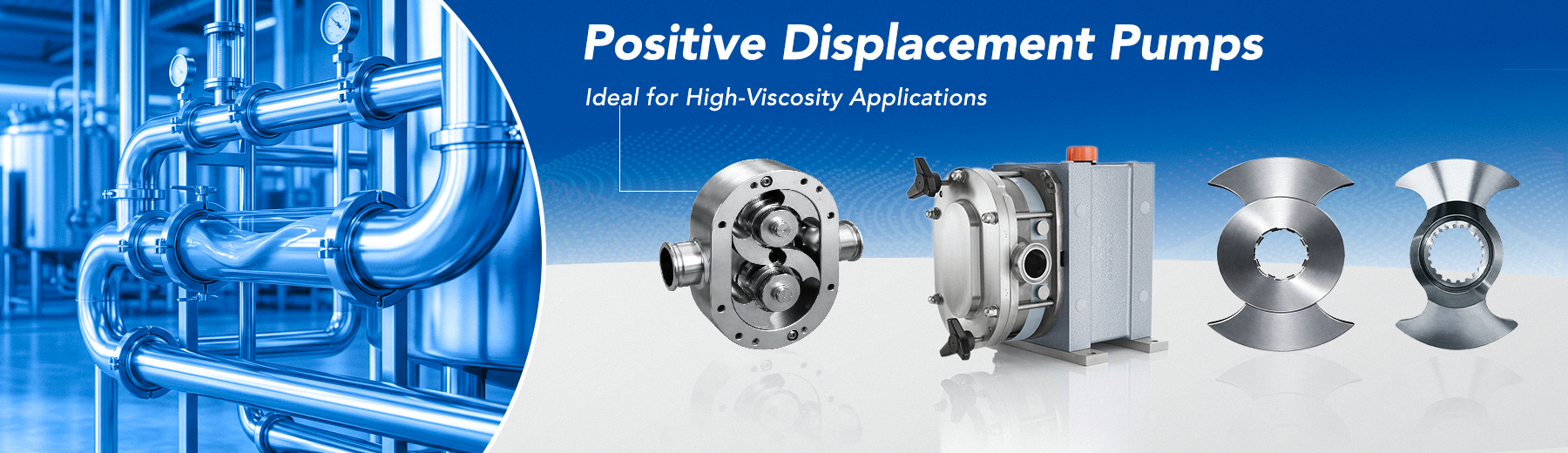
High-viscosity fluids act very differently from water-like liquids. They resist flow and push back hard. The machinery inside the pipeline experiences a rapid increase in pressure. In such environments, pump selection is not a casual decision. It directly impacts productivity and product integrity. A positive displacement pump is widely used for thick and resistant matter. It works with force, not just speed. Unlike dynamic pumps that depend on velocity and kinetic energy, a positive displacement pump moves a fixed volume during every rotation cycle. Flow stays stable even when discharge pressure changes suddenly. As viscosity increases, efficiency often improves. Thicker fluids reduce internal slip and seal clearances more effectively.
For industries dealing with syrups, creams, oils, or gels, choosing the correct pump for high viscosity fluid is not just a technical choice. It shapes uptime, maintenance cost, and final product quality.
What are Positive Displacement Pumps?
A positive displacement pump is a mechanical system that transfers fluid by trapping a defined volume inside a chamber. It then forces that volume toward the discharge port. The displacement occurs through rotating components such as lobes, screws, or pistons. These pumps create sealed cavities to move fluid. Unlike centrifugal pumps that use speed to create flow, positive displacement (PD) pumps deliver a consistent, stable output regardless of pressure changes. Across many types of pumps used in industries, PD pumps prove more dependable when liquids become thick and difficult to move. They keep pushing even when resistance builds.
Positive Displacement Pump Working Principle
The positive displacement pump working principle is simple, direct, and reliable:
- A measured volume of liquid is captured inside a sealed chamber.
- Rotating elements transport the trapped liquid toward discharge.
- Mechanical force pushes fluid against system resistance.
- Flow rate remains nearly constant despite pressure variation.
- Internal clearances restrict backflow, especially with viscous fluids.
Types of Positive Displacement Pumps
Several positive displacement pump types are designed for different processing demands. Selection depends on viscosity level, hygiene requirements, solids presence, and discharge pressure. Each configuration solves a different operational challenge.
Hygienic and efficient in design. These pumps use non-contacting lobes to move product smoothly through the chamber. They are widely applied in food, dairy, and personal care industries where cleanliness and gentle transport are critical.
Highly versatile in operation. Twin screw pumps manage process fluids and CIP cycles using the same unit. Fristam FDS and FDS TSG systems operate across wide speed ranges. They perform reliably as a pump for high viscosity fluid and also handle thin cleaning liquids without needing replacement equipment.
Understanding the Science Behind Viscous Fluid Transfer
1. The Slip Advantage
In a PD system, fluid is trapped inside cavities formed by rotors or screws. Slip refers to minor backflow through narrow internal gaps. With thin fluids like water, slip is higher, and some fluid escapes backwards. With thick fluids like syrup or cream, the liquid cannot pass easily through those gaps. The pump effectively seals itself. Pumping capacity increases as viscosity rises.
2. Shear Sensitivity
Many high-viscosity fluids are structurally delicate. Centrifugal impellers rotate at high speeds and disturb the fluid composition aggressively. Fristam FKL circumferential piston pumps and FDS twin screw models use controlled rotary motion instead. They move fluidly within defined cavities. Texture and consistency remain intact during transfer.
3. Pressure Independence
Viscous liquids generate substantial head pressure in pipelines. A centrifugal pump loses flow when resistance increases. A high-pressure positive-displacement pump maintains a steady output regardless of rising back pressure. Flow remains predictable and linear. That stability is essential for metering and dosing processes.
Why PD Pumps Excel at Handling High-Viscosity?
A positive displacement pump performs better with thick materials because it relies on mechanical displacement rather than velocity. It forces the product forward with each rotation. Resistance does not reduce flow significantly. In fact, as viscosity increases, internal slip decreases, and overall efficiency may improve. That behaviour surprises many engineers at first.
PD pumps deliver measurable and consistent flow rates. Pressure fluctuations do not drastically change performance. Many positive displacement pump applications involve shear-sensitive materials such as creams, gels, and food pastes. Lower rotational speeds protect the product structure. Transfer becomes controlled and reliable.
These systems are also engineered to tolerate high-pressure conditions. A high-pressure positive displacement pump like Fristam’s FKL series can manage discharge pressures up to 35 bar. That capability supports heavy oils, adhesives, peanut butter, and industrial polymers. Structural strength matters here. The design is built for long service life.
Fristam’s Advanced PD Engineering for Demanding Fluids
Fristam has developed specialised positive displacement pump types capable of handling viscosities up to 1,000,000 cP. Engineering decisions focus on durability, hygiene, and long-term operational stability.
- Handles pressures up to 35 bar with controlled stability
- An extended sealing path minimises slip effectively
- Shaft diameter up to 25% larger than typical competitors
- Resists deflection under extreme viscous load conditions
- Dual duty operation for process and CIP
- Operates at low speeds for thick viscous products
- Runs up to 3,600 rpm for thin cleaning fluids
- Maintains hygienic construction and gentle transport
Compared to other types of pumps used in industries, Fristam PD systems maintain constant linear flow and reduce shear impact. They handle extreme viscosities where centrifugal solutions struggle. Performance differences become obvious in real production lines.
Industries Where Positive Displacement Pumps Handle Thick Liquids
Transfers peanut butter, chocolate, syrups, and sauces efficiently. Hygienic construction and gentle movement preserve taste and texture quality.
Pumps yoghurt, cream, and condensed milk products. Low shear transfer ensures structural stability during processing.
Moves lotions, gels, creams, and ointments accurately. Smooth and controlled flow prevents formulation breakdown.
- Oil and Polymer Processing
Handles heavy oils, resins, adhesives, and lubricants. High-pressure capability and mechanical durability are required here.
Transfers viscous medicinal gels and suspensions safely. Sanitary design and precise metering support regulatory compliance.
Conclusion
When viscosity increases, pumping complexity increases as well. Pressure rises, and energy demand follows. A positive displacement pump addresses these challenges through direct mechanical displacement. Flow remains stable under resistance. Efficiency improves with thicker fluids in many cases. Product integrity stays protected due to low shear motion. Fristam’s FKL and FDS technologies enhance this performance with reinforced shafts, optimised sealing paths, and flexible speed capability. For industries where reliability is critical, PD pumps remain a practical and proven solution.
Frequently Asked Questions
1. Why is a PD pump better for thick fluids than a centrifugal pump?
Because it uses direct mechanical displacement instead of relying on velocity.
2. Can PD pumps handle both thin and thick liquids?
Yes, especially twin screw systems with wide speed control ranges.
3. Do PD pumps maintain flow under high pressure?
Yes, output remains steady even when discharge pressure increases.
4. Are PD pumps suitable for hygienic industries?
Yes, many models are designed for sanitary and CIP operations.
5. What industries commonly use PD pumps?
Food, dairy, cosmetics, oil processing, and pharmaceutical manufacturing sectors.